

Splitting a restaurant bill by item means assigning each dish, drink, and side to the person who actually ordered it, then dividing tax and tip in proportion, so everyone pays for exactly what they had. It is the fairest way to handle a shared check, and it removes the quiet resentment that builds when the person who ordered a salad and water subsidizes the table that ordered steaks and cocktails. Modern tools like Call It Even make item-level splitting fast by scanning the receipt, pulling out each line, and doing the tax-and-tip math automatically, so fairness stops being a negotiation.
How do you split a restaurant bill by item?
You split a restaurant bill by item by listing every line on the receipt, assigning each one to whoever ordered it, and then adding each person’s share of the tax and tip on top of their subtotal. The result is a per-person total that reflects what they actually consumed, not a flat average of the whole table.
The process has three moving parts: the items themselves, the shared items that more than one person split, and the tax and tip that apply to everyone. Get those three right and the math is airtight. Most disputes at the end of a meal come from skipping one of them — usually the tip, which people either forget or divide evenly even though the rest of the bill was itemized.
Doing this by hand works for a table of two or three. Past that, a receipt with fifteen lines and eight people becomes a spreadsheet problem, which is exactly where an app earns its place.
Why is splitting by item fairer than splitting evenly?
Splitting by item is fairer than splitting evenly because it charges each person for their own spending instead of averaging everyone’s choices together. An even split quietly transfers money from the light spenders to the heavy spenders every single time.
An even split is fine when everyone orders roughly the same thing. It breaks down fast in common situations:
- Different appetites. One person orders a $14 bowl; another orders a $38 entrée plus two $16 cocktails. An even split makes the first person pay for the second’s night out.
- Non-drinkers at the table. Alcohol is often the biggest swing on a check. People who did not drink should not split the bar tab.
- Dietary or budget differences. Someone eating light for health or cost reasons ends up penalized for it under an even split.
- One person who skipped a course. Arriving late or leaving early should change what you owe.
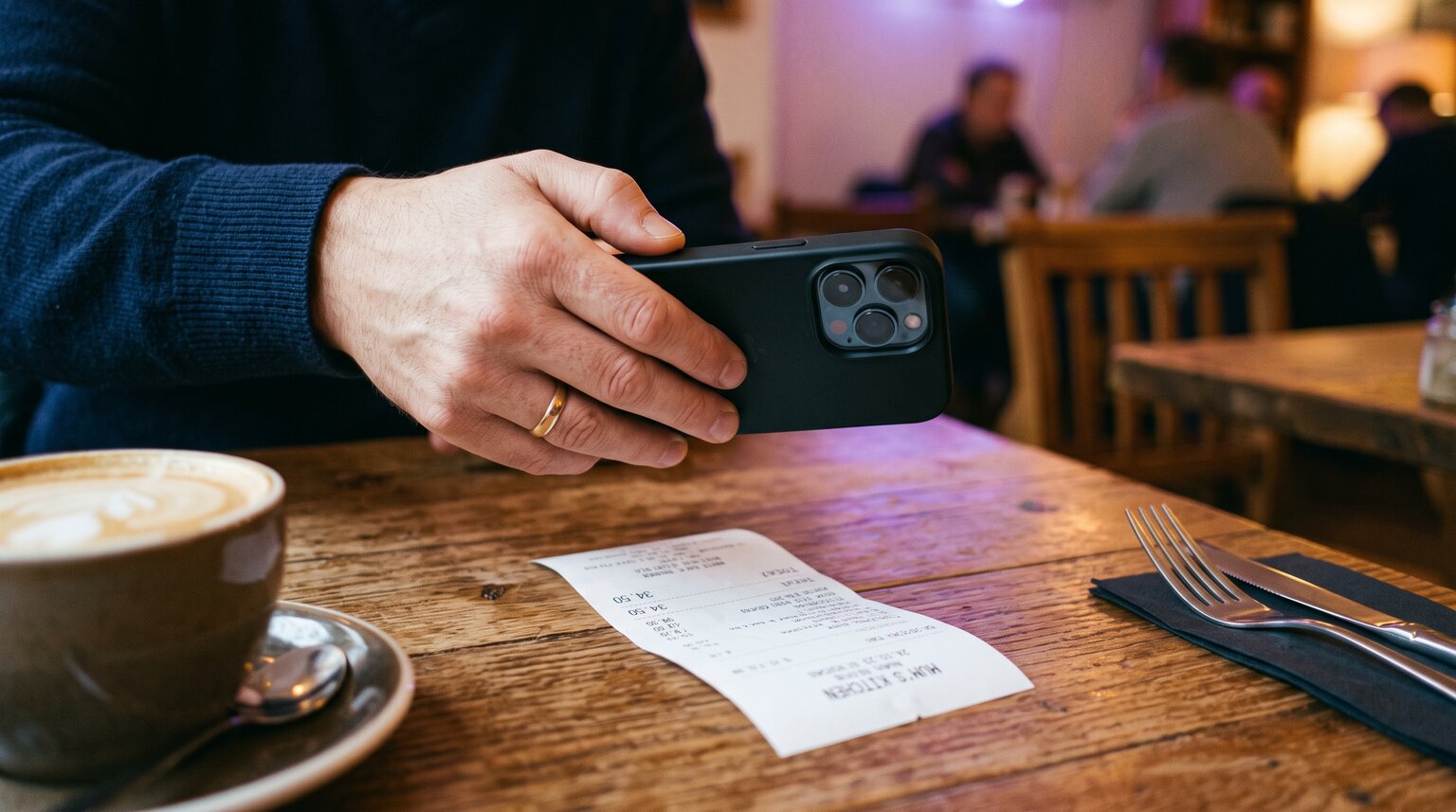
There is a social cost to getting this wrong. When the same people consistently overpay, they stop suggesting group dinners. Itemized splitting keeps the table balanced, which keeps the invitations coming.
How do you handle tax and tip when you split by item?
You handle tax and tip by applying them proportionally, in the same ratio as each person’s share of the pre-tax subtotal. The person whose food and drinks made up 30 percent of the bill pays 30 percent of the tax and 30 percent of the tip.
This matters more than people expect. Gratuity in the United States commonly runs 18 to 22 percent, and sales tax adds several more percent on top. Together they can be a quarter of the check. Dividing that quarter evenly, while itemizing the rest, undoes most of the fairness you were trying to create.
Here is the difference on a simple two-person example where the subtotal is $60, tax is $5, and the tip is $12 (a $77 total):
| Person | Food ordered | Even tax + tip | Proportional tax + tip |
|---|---|---|---|
| Ordered $45 | 75% of subtotal | $8.50 | $12.75 |
| Ordered $15 | 25% of subtotal | $8.50 | $4.25 |
Splitting the $17 of tax and tip evenly overcharges the light eater by more than four dollars on a small bill. Scale that to a table of eight and the distortion becomes real money.
Pro Tip: Calculate tip on the pre-tax subtotal, then split that tip in the same proportion as the food. Tipping on the post-tax total quietly inflates everyone’s tip and muddies the math.
How do you split shared dishes and drinks?
You split a shared dish by dividing its cost only among the people who actually shared it, not the whole table. A plate of nachos split by three people is a three-way split on that one line, while the rest of the bill stays itemized per person.
Shared items are where hand math gets tedious and where most rounding errors sneak in. The common cases:
- Appetizers for the table. Split among everyone who ate them. If two people abstained, they are not on that line.
- A bottle of wine. Split among the drinkers only, usually evenly unless someone had a single glass.
- Dessert to share. Divide by the number of forks that actually reached for it.
- A group platter or family-style order. Split evenly among participants, then treat it as one assigned line.
The principle is simple: every line on the receipt belongs to one or more specific people. Once each line has an owner, the totals fall out on their own.
What is the fastest way to split a restaurant bill by item?
The fastest way to split a bill by item is to photograph the receipt and let an app extract the line items for you, then assign each one to a person with a tap. What used to take ten minutes of squinting and arithmetic takes under a minute.
AI receipt scanning reads each line off the printed receipt, so you never retype prices. You drag or tap each item to the person who ordered it, mark shared items for the people who split them, and the app calculates every person’s subtotal plus their proportional tax and tip. Because the tax and tip follow the items automatically, the fairness is built in rather than bolted on.
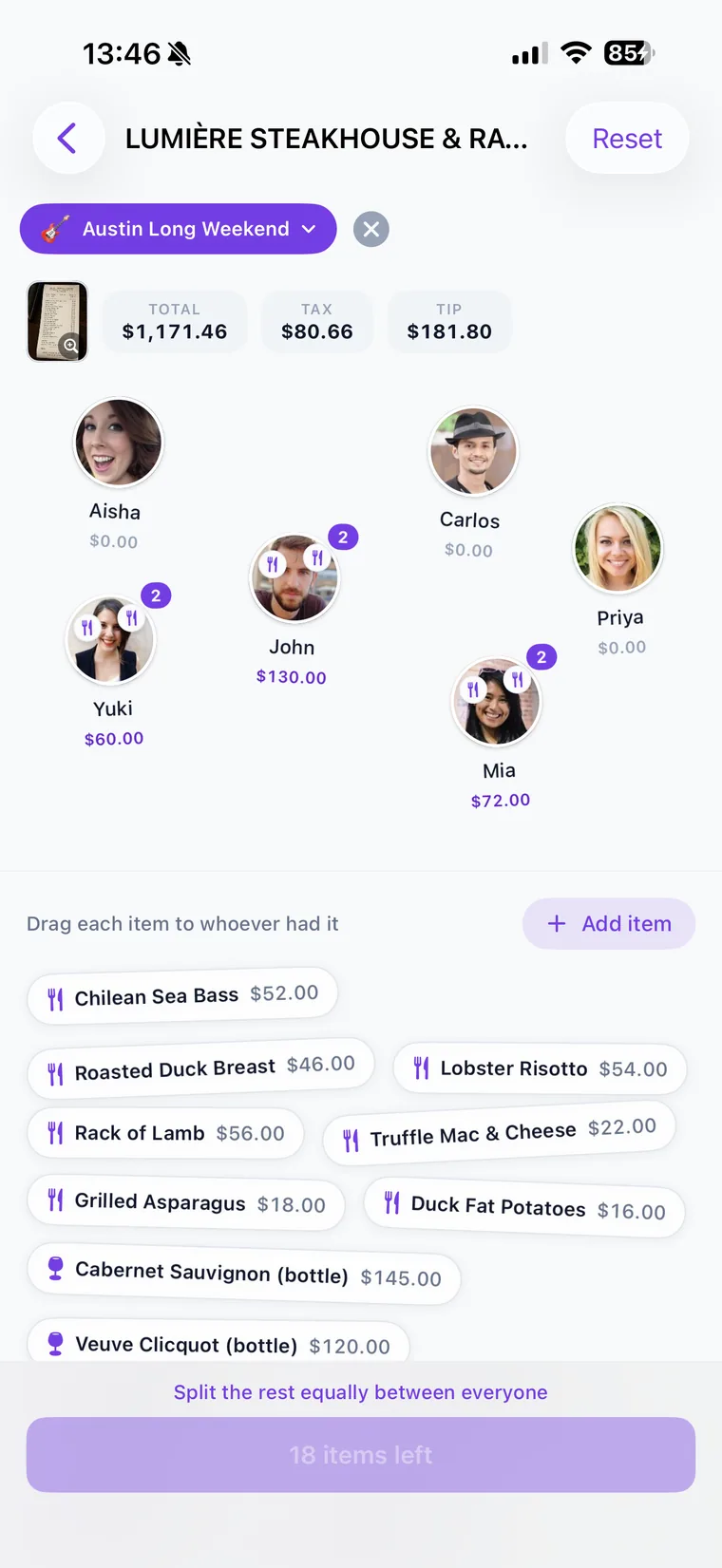
This is the core of how Call It Even handles a restaurant check. Scan, assign, done — and because it keeps a running ledger, the amounts flow straight into who-owes-who across the whole group, not just this one meal.
How to split a restaurant bill by item, step by step
Splitting an itemized check follows the same sequence whether you do it by hand or in an app.
- Capture the receipt. Take a clear photo, or type in the line items if you are doing it manually.
- Assign each item. Give every line to the person who ordered it. Mark shared items and choose who split them.
- Total each person’s food. Add up the items assigned to each person to get their pre-tax subtotal.
- Apply tax and tip proportionally. Give each person the same percentage of tax and tip as their share of the subtotal.
- Confirm the totals reconcile. The sum of everyone’s totals should match the final bill to the cent.
- Settle up. Record who paid the server and let everyone repay their share however they like — cash, a payment app, or a transfer.
The last step is where a shared ledger pays off. Instead of five separate paybacks after every dinner, the amounts accumulate and you settle up in one clean move when it is convenient.
Common mistakes when splitting a bill by item
Most itemized-split errors come from a handful of predictable slips. Knowing them keeps your totals honest.
- Splitting tip evenly on an itemized bill. The single most common mistake. Keep the tip proportional to the food.
- Tipping on the post-tax total. Small per person, but it adds up and inflates everyone’s share.
- Forgetting shared items have limited owners. Charging the whole table for an appetizer two people ate is just a hidden even split.
- Rounding in your own favor. Rounding each share up leaves the payer short. Let the app carry the cents.
- Waiting until later to split. Memories fade and receipts get lost. Split at the table while it is fresh.
The table below shows which approach fits which kind of meal.
| Situation | Best split method |
|---|---|
| Everyone ordered similar entrées | Even split |
| Wildly different orders or a big bar tab | By item, proportional tax and tip |
| A few shared plates, mostly individual orders | By item, with shared lines split |
| Set-price group menu | Even split among attendees |
| Large group with a long receipt | Scan the receipt and assign per item |
The goal is not to nickel-and-dime your friends. It is to make the money invisible, so the only thing anyone remembers about dinner is the dinner.
Call It Even makes splitting by item effortless
Call It Even is built for exactly this moment: a table of friends, one long receipt, and nobody wanting to do math. Point your camera at the check and the app reads every line, you assign each item to whoever ordered it, and the tax and tip split themselves in proportion, down to the cent.
There are no bank details, no fees, and no spreadsheets — Call It Even keeps the ledger while you and your friends settle up however you already do. It also handles group trips, multiple currencies, and friends who are not on the app yet. Get Call It Even and turn the end-of-dinner scramble into a five-second scan.
Key takeaways
Splitting a restaurant bill by item is the fairest way to share a check, and it is only tedious when you do it by hand.
| Point | Details |
|---|---|
| Assign every line an owner | Each item belongs to the person who ordered it, or to the people who shared it. |
| Keep tax and tip proportional | Divide them in the same ratio as each person’s food, never evenly on an itemized bill. |
| Split shared items narrowly | A shared plate is split only among the people who ate it, not the whole table. |
| Scan to save time | Receipt scanning extracts line items so a long check takes under a minute. |
| Settle from a running ledger | Let the amounts accumulate and settle up once, instead of paying back after every meal. |
FAQ
How do you split a bill by item with tax and tip?
Assign each item to the person who ordered it, total each person’s food, then add tax and tip in the same proportion as their share of the subtotal. A person who ordered 30 percent of the food pays 30 percent of the tax and tip.
Is it rude to split a restaurant bill by item?
No. Splitting by item is widely accepted and is usually fairer to everyone at the table. Using an app to do it quietly and quickly avoids the awkward part, which is the out-loud arithmetic, not the fairness itself.
How do you split a shared appetizer or bottle of wine?
Split the cost of a shared item only among the people who actually shared it. A bottle of wine splits among the drinkers, and an appetizer splits among the people who ate it, while the rest of the bill stays itemized per person.
What is the easiest app to split a bill by item?
An app with receipt scanning is easiest because it extracts the line items for you and calculates proportional tax and tip automatically. Call It Even does this for free, with no bank details required, and keeps a running balance so groups can settle up in one step.
Should you tip on the pre-tax or post-tax total?
Tipping on the pre-tax subtotal is the standard and keeps the split cleaner. Tipping on the post-tax total slightly inflates the tip and makes the per-person math less transparent when you divide it by item.
Recommended
- The stress-free way to handle group trip expenses – Call It Even
- Settling Up – Call It Even
- Group Trips – Call It Even
- Travel – Call It Even