
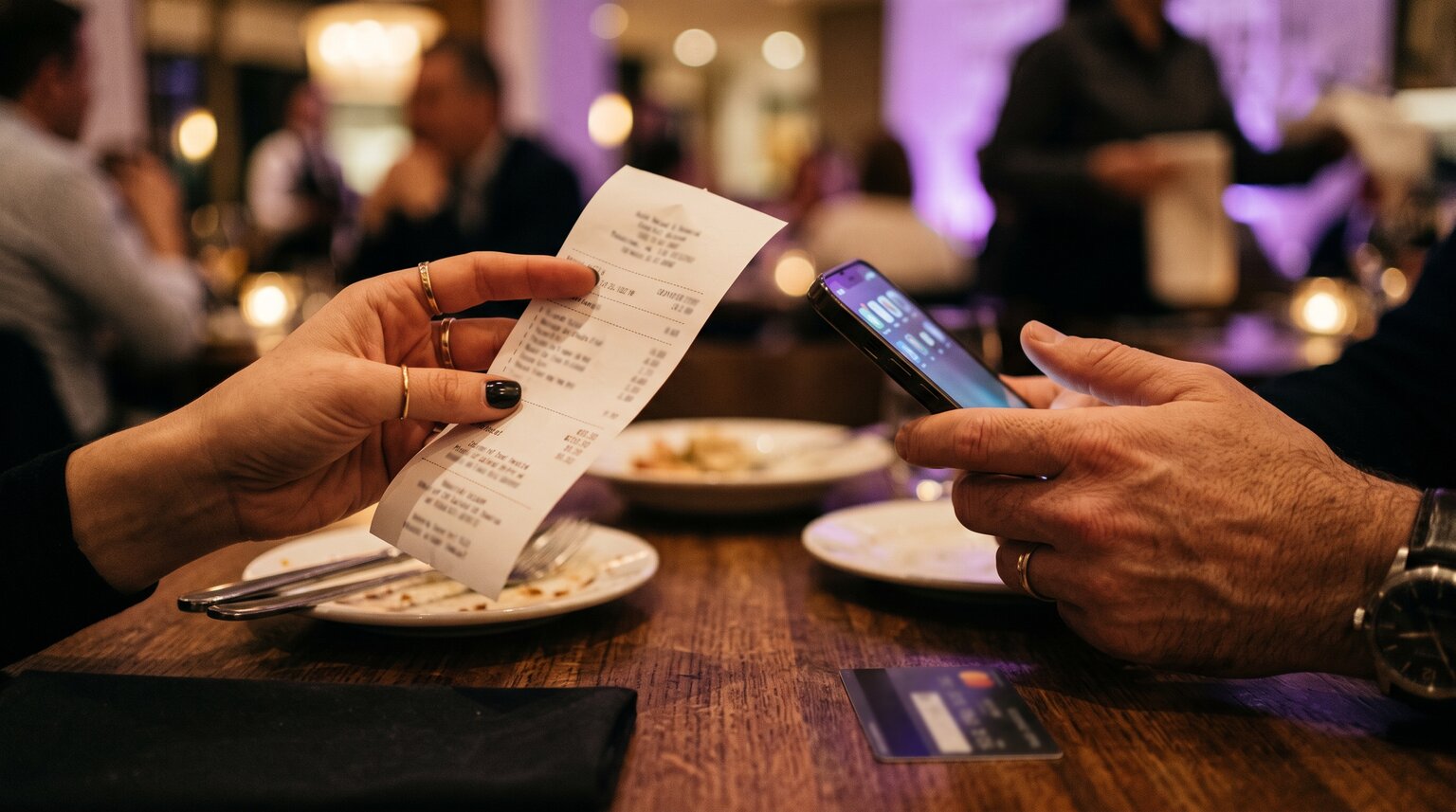
The fairest way to split a bill depends on the situation: split evenly when everyone ordered and consumed roughly the same, and split by item when orders diverge or a big bar tab skews the check. Neither method is universally “fair” — fairness is about matching the split to reality, and always defaulting to an even split quietly overcharges the light spenders every single time. Call It Even lets you pick an equal or exact-amount split per expense, and itemize straight off a scanned receipt, so you use the right tool for each bill instead of forcing one method onto every situation.
Should you split the bill evenly?
You should split the bill evenly when everyone at the table ordered and consumed about the same amount — same entrée tier, same number of drinks, no big outliers. In that case an even split is not only fair, it is faster and friendlier than itemizing, because there is nothing meaningful to itemize.
Equal splitting is the default for a reason. It is instant, it requires no receipt archaeology, and it signals trust: nobody is counting who had the extra side. The problem is not the method, it is applying it reflexively to bills where the orders were not equal at all.
A quick gut check before you split evenly:
- Did anyone skip alcohol? Drinks are usually the biggest swing on a check, so a non-drinker at the table is the clearest signal to itemize.
- Did the orders land in the same price range? A $16 bowl next to a $42 steak is not an even table.
- Did everyone actually eat? Someone who arrived for coffee should not subsidize a three-course meal.
If all three pass, split evenly and move on. If any one fails, the even split is transferring money from someone who did not agree to pay it.
Is it fair to split the bill evenly?
Splitting evenly is fair only when consumption was roughly equal; otherwise it is a hidden subsidy from the light spenders to the heavy ones. The math feels equal because everyone pays the same number, but the value received is not equal, and that gap is exactly where resentment builds.
Consider a table of four where the bill comes to $200. Split evenly, everyone pays $50. But if one person ordered a $20 salad and water while another ordered a $60 steak and three cocktails, the salad-eater just paid a $30 premium for a meal they did not have. Do that a few times and they quietly stop suggesting group dinners.
This is the hidden unfairness of always-equal splitting: it is invisible on any single night and corrosive over many. The fix is not to abandon even splits, but to reserve them for the bills that genuinely warrant them and itemize the ones that do not.
Equal vs itemized vs percentage vs shares: how do they compare?
The four common split methods each fit a different kind of situation, and knowing which is which is most of the battle. Equal divides the total evenly, itemized assigns each line to whoever consumed it, percentage divides by agreed proportions, and shares divides by counted units like people or rooms.
| Method | How it divides | Fairest when | Example |
|---|---|---|---|
| Equal | Total ÷ number of people | Everyone consumed about the same | Four friends sharing pizzas |
| Itemized | Each line to its owner + proportional tax/tip | Orders differ or there is a bar tab | A restaurant check with mixed orders |
| Percentage | Agreed % per person | Incomes or usage differ by known ratios | Rent split 60/40 by room size |
| Shares | Total ÷ counted units per person | People represent different weights | A couple counts as two shares of groceries |
Note: Call It Even itself splits equally or by exact amounts. Percentage and share-based outcomes are easy to achieve — agree the ratio, work out each person’s figure, and enter those as exact amounts; the app checks they add up to the total.
Itemized is the most precise, but precision is not always the point. For a $28 coffee run, itemizing is overkill; an even split is the socially correct answer. Percentage and shares shine for recurring, structural costs — rent, utilities, a shared house — where the imbalance is stable and agreed in advance rather than argued line by line.
Pro Tip: Match the method to the volatility of the bill. One-off meals with similar orders want equal; meals with wild orders want itemized; recurring household costs want percentage or shares set once and reused.
When is itemized splitting worth the effort?
Itemized splitting is worth the effort whenever the spread between the biggest and smallest order is large enough that an even split would visibly overcharge someone. The bigger the spread and the bigger the group, the more an itemized split pays off.
The clearest triggers to itemize:
- A bar tab. Alcohol is the single most common reason even splits feel unfair. Drinkers should carry the bar line, not the whole table.
- Wildly mixed orders. When appetites and prices diverge, the average stops representing anyone.
- Dietary or budget differences. Someone eating light for health or cost reasons should not be penalized for it.
- Partial attendance. Arriving late or leaving before dessert should change what you owe.
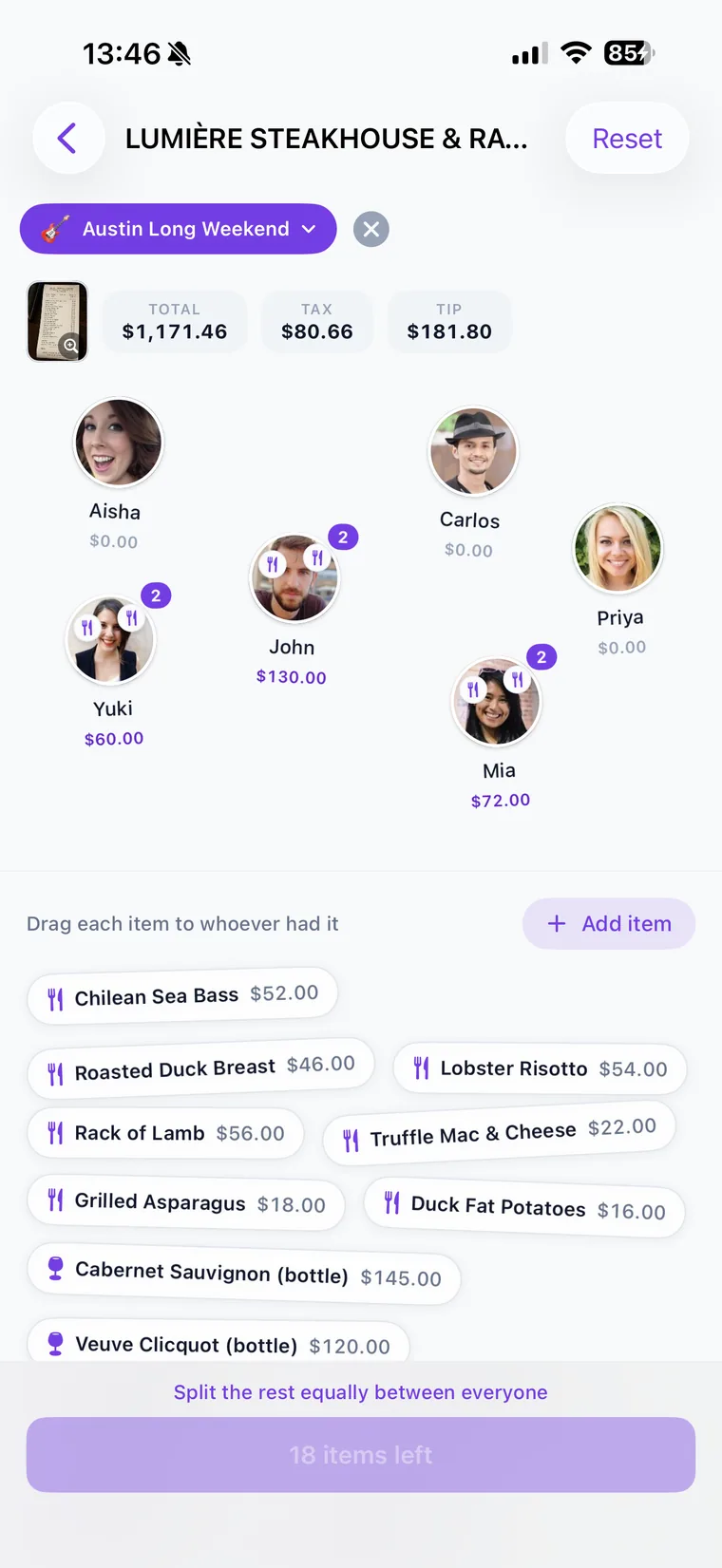
The historical objection to itemizing was speed: nobody wants to squint at a receipt and do fifteen lines of arithmetic while the server waits. That objection is now obsolete. AI receipt scanning reads each line off the printed check, you assign items with a tap, and the tax and tip split themselves in proportion — turning a ten-minute negotiation into a sub-minute task. When itemizing is that fast, the effort argument for defaulting to equal largely disappears.
How do you pick a split method fast?
You pick a split method fast by asking one question: did everyone consume about the same? If yes, split equally. If no, ask whether the imbalance is a one-off (itemize) or a standing arrangement (percentage or shares).
A three-second decision tree covers almost every bill:
- Roughly equal orders? Split evenly and stop here.
- Different orders or a bar tab? Itemize — scan the receipt and assign each line.
- A recurring cost with known ratios? Use percentage (by income or usage) or shares (by counted units).
The point of picking fast is to avoid the two failure modes: over-itemizing a trivial bill (which feels stingy) and under-itemizing a lopsided one (which feels unfair). The method should be a two-second reflex, not a debate. Getting the reflex right is what keeps the money invisible and the invitations flowing.
How do you handle tax and tip fairly?
You handle tax and tip fairly by dividing them in the same proportion as the split you chose, never on a different basis than the food. On an itemized bill, that means each person carries the same percentage of tax and tip as their share of the subtotal.
This is where a lot of “itemized” splits quietly become unfair. People carefully assign every dish, then split the tip evenly — undoing most of the fairness they just created. Fair division is only as fair as its weakest step, and tax plus tip can be a quarter of the check. If the food is itemized, the tax and tip must follow the food, not the headcount. A good tool does this automatically, so proportional tax and tip is the default rather than something you have to remember.
The goal was never to nickel-and-dime your friends. It is to make the money match reality closely enough that nobody thinks about it — so the only thing anyone remembers about dinner is the dinner.
Call It Even makes fair splitting effortless
Call It Even is built so the fair method is always the easy one. Every expense lets you choose equal or exact amounts, so you match the split to the situation instead of forcing one method onto every bill. When a check is lopsided, point your camera at it: the app reads each line, you assign items with a tap, and tax and tip split in proportion down to the cent.
There are no bank details, no fees, and no spreadsheets — Call It Even keeps the ledger while you and your friends settle up however you already do. It also handles group trips, multiple currencies, recurring bills, and friends who are not on the app yet. Get Call It Even and let the right split method be a one-tap choice.
Key takeaways
Fairness is about matching the split method to the bill, not about always choosing the same one.
| Point | Details |
|---|---|
| Equal is fair only when equal | Split evenly when everyone consumed about the same; otherwise it subsidizes heavy spenders. |
| Itemize lopsided bills | Bar tabs and mixed orders are the clearest signals to assign each line to its owner. |
| Proportional splits for recurring costs | Rent, utilities, and shared houses fit agreed ratios — settle the proportions once, then enter each figure as exact amounts. |
| Tax and tip follow the food | Divide them in the same proportion as the split, never evenly on an itemized bill. |
| Pick fast, keep money invisible | One question — equal consumption? — routes almost every bill in seconds. |
FAQ
Should you always split the bill evenly?
No. Split evenly only when everyone ordered and consumed about the same amount. When orders differ or there is a bar tab, an even split overcharges the light spenders, and itemizing is fairer. The right default is to check consumption first, then choose.
Is it fair to split the bill evenly with a non-drinker at the table?
Usually not. Alcohol is often the biggest swing on a check, so splitting a bar tab evenly makes non-drinkers pay for drinks they did not have. Itemize the bill, or at minimum pull the bar total out before dividing the food.
What is the difference between percentage and shares splitting?
Percentage divides a bill by agreed proportions, like rent split 60/40 by room size. Shares divides by counted units, like a couple counting as two shares of groceries. Both suit recurring costs where the imbalance is stable and known in advance. Call It Even itself splits equally or by exact amounts, so you agree the proportion once, work out each person’s figure, and enter those amounts — the app checks they add up to the total to the cent.
Is itemized splitting worth it for small bills?
Rarely. For a small, similar-order bill like a coffee run, an even split is faster and socially smoother. Itemizing pays off when the spread between orders is large or the group is big, especially with receipt scanning doing the math for you.
What is the best way to split a bill fairly?
The best way is to match the method to the situation: equal for similar orders, itemized for mixed orders or bar tabs, and an agreed proportion for recurring household costs. Call It Even splits equally or by exact amounts — for a proportional arrangement you settle the ratio once, work out each figure and enter it — and it keeps a running balance so you settle up in one step.
Recommended
- Splitting Bills – Call It Even
- Split Methods – Call It Even
- Fairness – Call It Even
- How to Split an Itemized Receipt – Call It Even
- Should Friends Split Everything Evenly? – Call It Even
- How to Split a Friendsgiving or Holiday Dinner – Call It Even
- The Best Expense Splitting App for iPhone – Call It Even
- How to Split Tax and Tip on a Group Bill – Call It Even