

A gift exchange works when everyone spends the same amount on one person, and it falls apart when the budget is vague, the group is uneven, or someone ends up fronting the whole thing. Secret Santa exists precisely to stop a group of twelve buying eleven presents each — but the money side still needs a number, a deadline and somebody keeping track. Call It Even handles the shared costs around the exchange, which is usually where the real money and the real awkwardness sit.
What is a good Secret Santa budget?
Pick one number, state it as a firm figure rather than a range, and set it low enough that the least well-off person in the group agrees easily. A range invites everyone to guess where the middle is, and somebody always guesses high, which makes everyone else’s gift look thoughtless through no fault of their own.
| Group | Typical budget | Why |
|---|---|---|
| Office or team | $20–$25 | Wide income range; keep it painless for everyone |
| Friend group | $25–$50 | People know each other well enough to buy properly |
| Extended family | $30–$50 | Replaces buying for fifteen relatives individually |
| White elephant | $15–$25 | The gift is a joke; the budget should match |
Whatever you choose, say “twenty dollars” and not “around twenty, but don’t worry if you go over”. The second version is how one person arrives with a forty-dollar gift and everyone else feels cheap.
How do you stop one person paying for everything?
Split the shared costs deliberately, because a gift exchange almost always has a hidden bill attached to it — the wrapping paper, the food, the venue, the drinks, the one big group gift for the person everyone agreed to club together for. That money lands on whoever organises it, and organisers famously never ask.
- Log the shared costs as one expense split across the group, separate from the gifts themselves.
- Club-together gifts for a boss, a teacher or a new parent should be split evenly and recorded, not collected in cash from memory.
- Don’t chase individuals — a visible balance does that job without anyone sending a message.
- Include people without the app. You can add someone by name and still track what they owe.
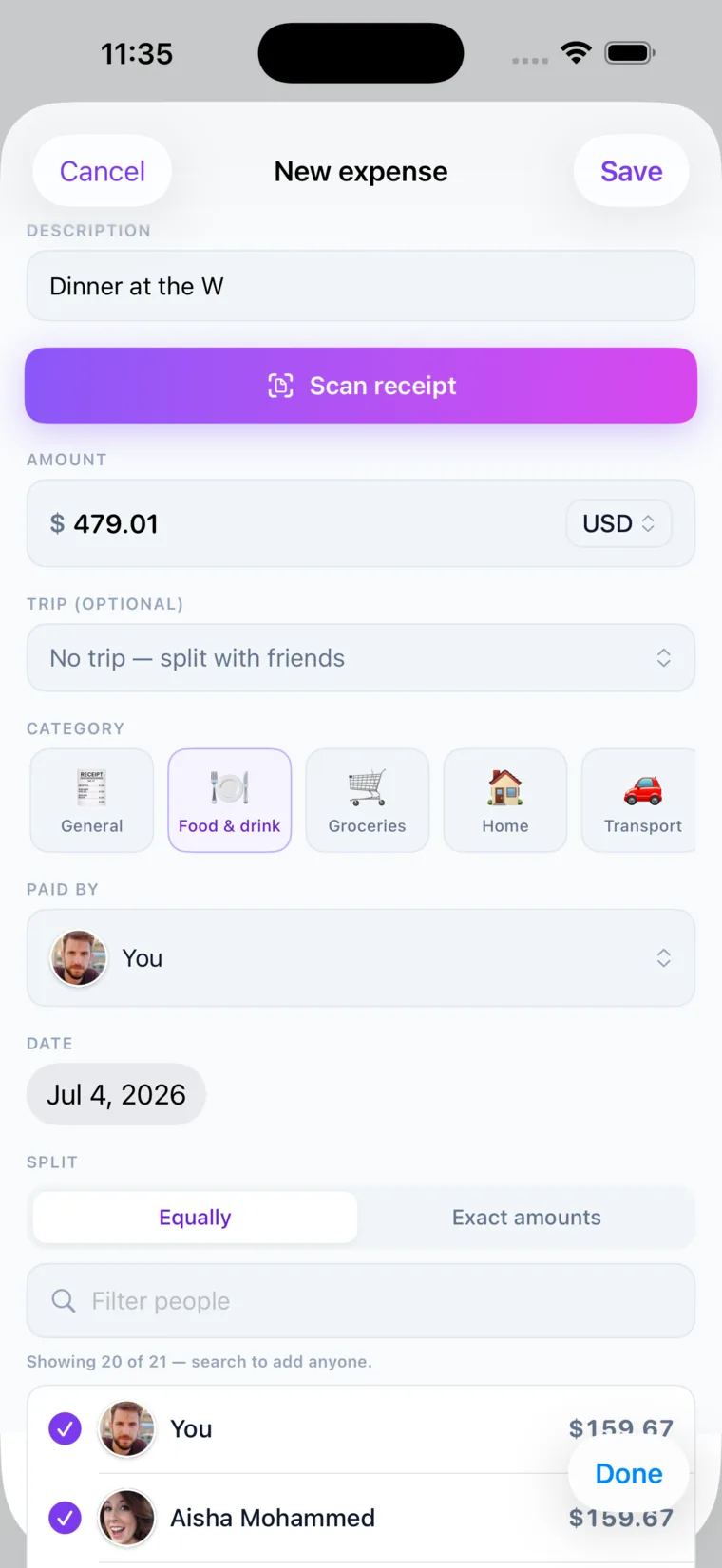
How do you split a group gift when not everyone can give the same?
Let people contribute what they can and record the actual amounts rather than pretending it was even. A group gift where one person gives $60 and another gives $15 is not unfair — it is two people giving generously relative to what they have. What is unfair is one of them quietly covering the shortfall and nobody knowing.
- Set a target, not a per-person charge, when contributions are voluntary.
- Record exact amounts so the ledger matches what really happened.
- Or split by percentage if the group agreed on shares rather than round figures.
- Keep the card signed by everyone regardless of who gave what. The gift is from the group.
Pro Tip: Give the exchange a deadline a week before the party, not the day of it. Every gift exchange has one person shopping on the morning, and a week’s buffer converts that into a much better present.
What rules actually make an exchange work?
Three: a fixed budget, a real deadline, and a drawing method nobody can quietly manipulate. Everything else is preference.
- Draw names randomly and privately — an online drawer avoids the person who reaches into the hat twice.
- Allow a wish list. It is not less thoughtful; it is how people get something they actually want.
- Decide on a theme or don’t, but decide before the draw, not after people have shopped.
- Say what happens if someone drops out, because in a group of twelve, someone will.
Secret Santa or white elephant — which should you pick?
Secret Santa if the group likes each other and wants real gifts; white elephant if the group is large, mixed, or mostly there for the game. The money behaves differently in each, which is worth knowing before you commit.
In Secret Santa each person buys for one named person, so the budget is the gift. In white elephant nobody knows who receives what, so the budget is the entry fee — and gifts should be genuinely usable by anyone in the room.
How do you settle up afterwards?
Settle the shared costs in one payment once the party is over, and leave the gifts alone entirely. Gifts are not debts and should never appear in a ledger; the food, the venue and the group gift are ordinary shared expenses and should.
- Separate the two in your head and in your records.
- One settlement covering the whole event, rather than a message per item.
- Keep it in one place so the organiser doesn’t have to remember who handed over cash.
Call It Even makes the money around a gift exchange simple: one expense for the shared costs, everyone’s share visible, one payment at the end. Get Call It Even free on iPhone, Android and the web.
Key takeaways
| Question | Answer |
|---|---|
| Budget | One firm figure, set low enough for everyone. Never a range. |
| The hidden bill | Wrapping, food, venue and club-together gifts — split them deliberately. |
| Uneven contributions | Record the real amounts, exactly or as percentages. Don’t pretend. |
| Rules that matter | Fixed budget, real deadline, a random private draw. |
| Gifts in the ledger | Never. Gifts aren’t debts; shared costs are. |
| Settling | One payment after the party, covering the shared costs only. |
FAQ
How much should you spend on Secret Santa?
Whatever single figure the group agrees, commonly $20–$25 for an office and $25–$50 among friends. State it as a firm number rather than a range, because a range makes one person overspend and everyone else look thoughtless.
Who pays for the food and drinks at a gift exchange?
The group, split evenly — but only if someone records it. These costs land on the organiser by default and are almost never mentioned, which is how one person ends up eighty dollars down on a party they hosted.
How do you split a group gift when people give different amounts?
Record what each person actually contributed rather than averaging it. Set a target instead of a per-person charge, enter the real figures as exact amounts, and let the card be signed by everyone regardless of who gave what.
What happens if someone drops out of Secret Santa?
Redraw the affected pair rather than leaving one person giftless, and agree this rule before the draw so it isn’t a negotiation on the day. In a group of a dozen, at least one person will drop out.
Should gifts go in a shared expense tracker?
No. A gift is not a debt, and logging one turns a present into an invoice. Track the shared costs around the exchange — food, venue, wrapping, any club-together gift — and leave the presents themselves out of it.
Recommended
- How to Split the Cost of a Group Gift – Call It Even
- How to Split a Friendsgiving – Call It Even
- How to Talk About Money with Friends – Call It Even
- Split Expenses – Call It Even