

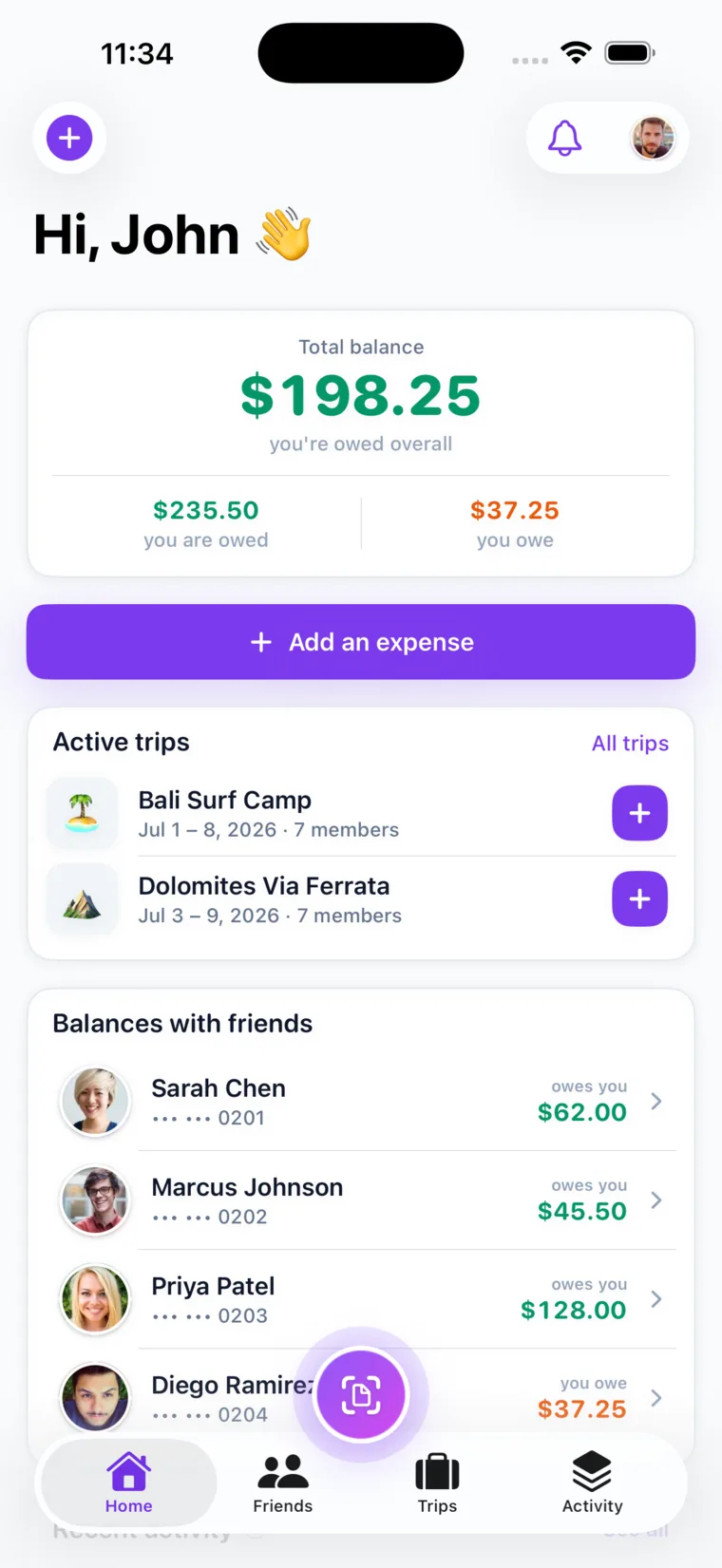
When one person pays for everything, the fix is to separate the two jobs they have accidentally taken on — fronting the money and remembering who owes what — and hand the second one to a shared ledger. Log each expense as it is paid, with them recorded as the payer, so the debt is visible to the whole group from the moment it exists rather than living in one person’s head. Call It Even does exactly this: everyone sees the same running balance, so the person holding the card never has to be the person sending reminders.
Why does one person always end up paying for everything?
Because paying is usually the fastest way to make the moment work, and speed compounds. Someone’s card is already on the table, already saved to the booking site, already the one with the good travel points. Each individual instance is trivial. Forty instances is a loan nobody agreed to.
- They are the organizer. Whoever books the house also books the table, the tickets, and the van.
- Their card is on file. Once a card is saved, it keeps getting used.
- They are chasing points. A rational choice that quietly makes them the group’s bank.
- They are the one who can float it. The most uncomfortable reason, and the most common one nobody says.
What is actually wrong with one person fronting everything?
Nothing is wrong with the fronting — the problem is the three unpaid jobs that come attached to it. Groups treat “you paid, so you’ll tell us what we owe” as a fair trade. It is not a trade at all; it is a second and third task handed to the person who already did the first one.
| The job | What it costs them |
|---|---|
| Being the bank | Real money, out of their account, for days or months. Sometimes a credit card balance carrying interest. |
| Being the bookkeeper | Remembering eleven charges across four apps, then doing arithmetic nobody checks. |
| Being the collector | The genuinely awful one — asking friends for money, twice, and being read as petty for it. |
A shared ledger removes the second and third entirely. The numbers are computed and visible to everyone, so nobody has to be told what they owe — they can already see it.
How do you log it so you actually get paid back?
Log the expense the moment you pay it, with yourself as the payer and everyone who benefited on the split. The single biggest predictor of getting paid back is not how you ask — it is whether the debt was visible on the day it was created.
- Log it at the register, not at the end of the trip. Ten seconds now beats an hour of reconstruction later, and reconstruction is where things get quietly rounded in the group’s favour.
- Attach the receipt. A photographed receipt ends the “was that really $240?” conversation before it starts. Call It Even can read an itemized receipt and turn it into a split, so a long grocery run does not have to be typed line by line.
- Split it honestly, including yourself. You are on the split too — you ate the dinner. The ledger tracks the difference between what you paid and what you owed.
- Let people see it as it grows. A balance that climbs in public gets settled. One that appears fully formed at the end feels like an invoice.
Pro Tip: The awkwardness of asking for money is almost entirely a surprise problem. Nobody minds owing $60 they have watched accumulate for a week. Everybody minds owing $60 they learn about on a Tuesday.
Should the person fronting keep the credit card points?
Yes, in most groups — they took on the risk, the cash-flow gap, and the admin, and the points are a reasonable counterweight. The friction only appears when the points are the unspoken reason they volunteered, and the rest of the group works it out later.
- Say it up front. “I’ll put the flights on mine for the miles, happy to be the one waiting to get paid back” is completely fine, and nobody resents it once it is said.
- Do not let points justify a slow repayment. They are compensation for fronting, not a reason the group can take three months.
- Rotate if it bothers people. One person takes the flights, another the house, another the dinners.
How do you fix it when nobody wrote anything down?
Reconstruct from statements, not memory, then post the list before you post the totals. If the trip is over and you are sitting on a card statement and a bad feeling, work backwards.
- Pull the statement and pick out every shared charge. Bank apps make this far easier than memory does.
- Enter each one separately with its real date, rather than one lump sum. A list of nine dated charges is checkable; “you all owe me $612” is an argument.
- Leave off anything you are not sure about. Absorbing a doubtful $18 buys more goodwill than it costs.
- Share the detail. A read-only link lets people see every line without needing an account, so the numbers answer their own questions.
Then agree the group stops doing it this way. The reconstruction is the last time it should ever be necessary.
How do you stop it happening again?
Split the fronting by category before the next trip, and settle on a rhythm rather than waiting for a total. Both are decisions made in advance, which is the only time they are easy to make.
- One person per category. You take accommodation, I take transport, she takes food. Everyone fronts something; nobody fronts everything.
- Set a settle rhythm. Weekly for a household, end-of-trip for a holiday, monthly for a shared bill. A ledger keeps a running balance with each person, so settling is one payment, not eleven.
- Automate the repeating ones. Rent, utilities and subscriptions can post themselves on a schedule and notify everyone, so nobody is manually re-entering the same bill twelve times a year.
- Keep it in the app, not the chat. Group chats scroll. Ledgers do not.
Pro Tip: Call It Even is a ledger, not a bank — it never holds or moves money. That is the point: you settle however you already pay each other, and recording it is what stops the reminders.
Key takeaways
| Problem | Fix |
|---|---|
| One person is the group’s bank | Fine, if said out loud. Split the fronting by category so it rotates. |
| They are also the bookkeeper and collector | Hand both to a shared ledger — the numbers are visible to everyone without anyone asking. |
| Debts arrive as a surprise | Log each expense the day it is paid so the balance grows in public. |
| Disputed amounts | Attach receipts; scan the long ones instead of typing them. |
| Nothing was written down | Reconstruct from the card statement, enter charges individually and dated, and drop anything doubtful. |
| Repeating bills | Put them on a schedule so they post and notify without anyone re-entering them. |
FAQ
How do you ask friends to pay you back without it being awkward?
Make the debt visible on the day it is created rather than announcing it later. Most of the awkwardness is surprise, not money — people rarely mind a balance they have watched accumulate, and they resent one that appears fully formed a week after the trip.
Should the person who pays for everything keep the credit card points?
In most groups, yes: they carry the cash-flow gap and the admin, and the points offset it. Just say so up front. The points are compensation for fronting, not a reason repayment can drag on.
What if nobody tracked anything during the trip?
Rebuild the list from your card statement rather than memory, enter each shared charge separately with its real date, and leave off anything you are unsure about. A dated list of individual charges can be checked; a single lump-sum demand starts an argument.
How do you stop one person paying for everything next time?
Assign one person per category before you go — accommodation, transport, food — so everyone fronts something and nobody fronts it all, and agree a settling rhythm rather than waiting for one final total.
Does Call It Even move the money for you?
No, and deliberately so. It is a ledger: it tracks who owes whom and never holds, moves, or requests funds. You pay each other however you already do — Venmo, Zelle, cash, a bank transfer — and record it in the app to close the loop.
Recommended
- How to Get Friends to Pay You Back – Call It Even
- How to Settle Debts in a Friend Group Fairly – Call It Even
- The Psychology of Who Owes Who – Call It Even
- Split Expenses & Settle Up – Call It Even
- How to Split the Cost of Being in a Wedding Party – Call It Even