

The way to split a shared family plan is to stop collecting it by hand: set the bill up once as a recurring expense that posts itself on the same day every month and tells everyone it has. One person’s card still pays Netflix, Spotify, or the phone company — but nobody has to remember to ask, and nobody has to remember to pay. Call It Even posts the charge on schedule, splits it the way you set, and notifies the group, so a family plan stops being a monthly chore.
Why do shared family plans always end up lopsided?
Because the payment is automatic and the collection is not. The subscription renews itself every month without anyone lifting a finger, while getting the other four people to send $4.60 requires a human being to notice, calculate, and ask. One side of that arrangement is a robot; the other side is your friend who is busy.
- The amounts are too small to chase. Nobody sends a reminder over $4.60, which is exactly why it goes unpaid for eleven months.
- The total is not small at all. $4.60 across four people for a year is $220 the plan owner quietly absorbed.
- The price keeps moving. Streaming services raise prices constantly, and the person collecting is usually still asking for last year’s number.
- Nobody remembers who is even on it. Plans accumulate a cousin, an ex, and someone’s old roommate.
How do you set up a split that runs itself?
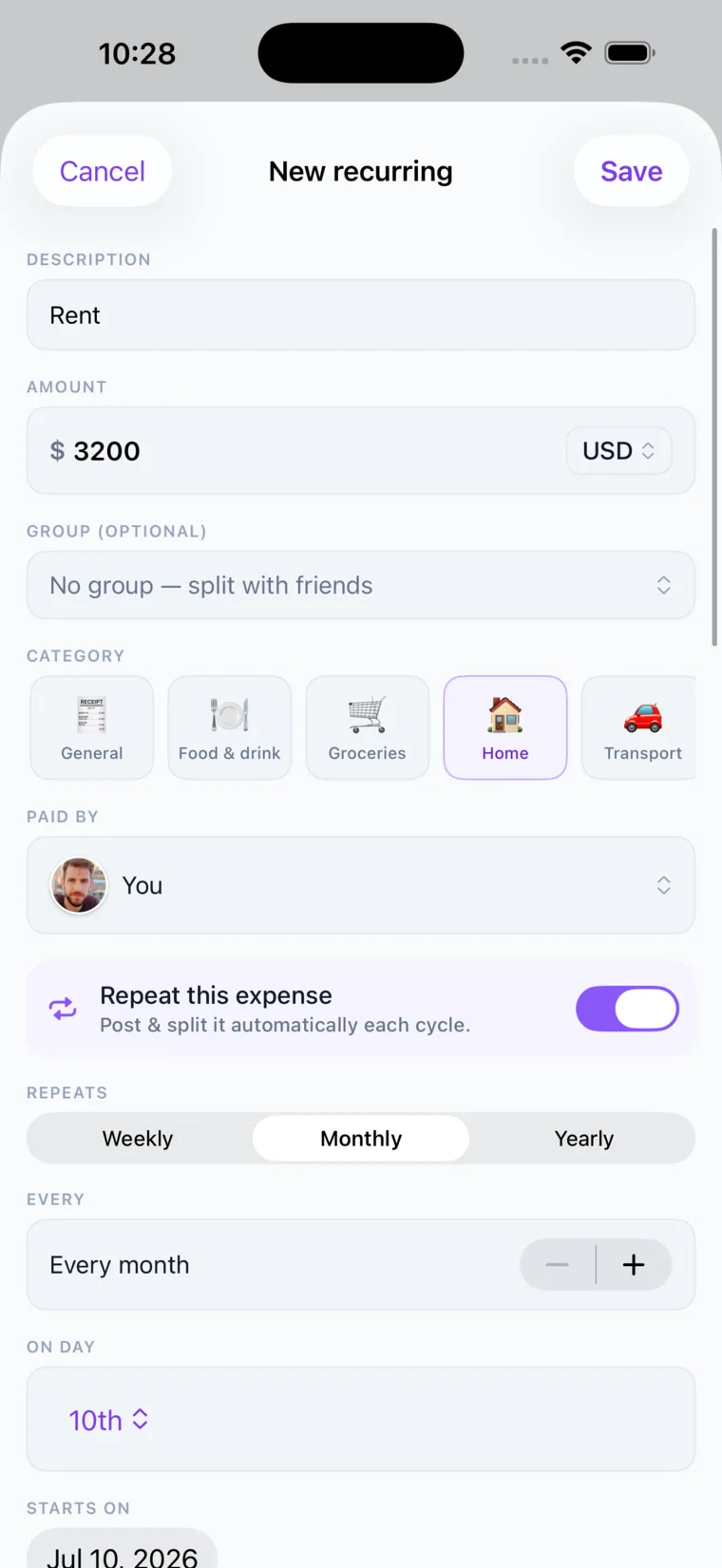
Create the expense once, mark it as repeating monthly on the day the plan actually bills, and let it post from then on. From that point the ledger does the noticing for you: the charge appears on the right day, split the way you chose, and everyone gets told.
- Use the real billing date. If Spotify takes its money on the 14th, set the 14th. A charge that lands the same day as the card is charged never feels arbitrary.
- Set it to notify. Everyone on the split sees it posted, so no one person is the announcer.
- Handle month-end properly. A plan that bills on the 31st still needs to post in February — set day 31 and it lands on the last day of shorter months rather than skipping them.
- Edits apply going forward. Changing the amount updates future charges and leaves the ones already posted alone, so history stays true.
How do you split a plan where people get different things?
Work out each person’s figure and enter it as an exact-amount split. Streaming plans are usually genuinely equal — everyone gets a profile — but phone plans almost never are, because one line has a device payment on it, another has extra data, and a third is a watch nobody remembers adding.
| Plan | Fair split | How to enter it |
|---|---|---|
| Streaming with equal profiles | Straight equal split | Split equally between everyone on it. |
| Phone plan, same allowance | Equal per line | Split equally between the line holders. |
| Phone plan with a device payment | Base per line, plus the device on the person using it | Work out each figure, enter as exact amounts. |
| Plan where one person barely uses it | Whatever you agree out loud | Work out each figure, enter as exact amounts. |
| Annual plan paid up front | Everyone’s share of the year | One expense on the renewal date, split among the group. |
To split a $180 phone bill where the base service is $30 a line for four lines and one person has a $60 phone on instalments: three people owe $30 and the fourth owes $90. Enter those four figures as an exact-amount split — Call It Even confirms the parts add up to $180 before it saves, so the device payment cannot silently get spread across everyone.
Pro Tip: Do the device-payment maths once, then let the recurring charge repeat it every month. The unfairness in phone plans is rarely deliberate; it is that nobody wants to redo that arithmetic twelve times a year, so the equal split stays.
What happens when the price goes up?
Edit the recurring expense to the new amount and it applies from the next charge onward. Price rises are the single most common reason a family-plan split drifts out of date — the owner absorbs the increase for months because updating the number means re-explaining it to five people.
- Update the amount, not the history. Charges already posted keep the price you actually paid, which is what makes the ledger trustworthy.
- Everyone is notified. The new figure arrives with the next charge instead of as an awkward message.
- Skip a month if you need to. If a promo month is free, skip that one occurrence and let the schedule continue.
What happens when someone leaves the plan?
Edit the recurring expense to drop them, and everyone else’s share goes up from the next charge. Leaving is the moment plans get genuinely unfair, because the remaining people keep paying their old share while the owner covers the gap.
- Change the split, not the plan. Editing forward means the months they were on it stay correct.
- Say the new number out loud. Four people paying $5.75 instead of five paying $4.60 is a real change and should not arrive as a surprise.
- Settle their balance before they go. A departing housemate with two unpaid months is a conversation that gets harder every week.
- Stopping is different from deleting. Ending a schedule leaves the charges already posted in place — you are stopping future ones, not erasing history.
Should you just collect once a year instead?
You can, and for very small amounts it is often more civilised — one $55 payment beats twelve $4.60 requests. The catch is that a year is long enough for people to leave, join, and forget, so it only works if the charges were logged each month even when the money was not moved.
- Log monthly, settle annually. The recurring charge posts every month and the balance simply grows.
- Settle when the balance is worth a payment. Call It Even keeps a running balance with each person; you pay however you already do and record it.
- Do not let it run forever. Two years of unpaid subscriptions is not a balance, it is a subsidy.
Pro Tip: Call It Even never touches your money — it is a ledger, not a bank. The subscription is still charged to one person’s card; what the app removes is the remembering, the arithmetic, and the asking.
Key takeaways
| Problem | Fix |
|---|---|
| Payment is automatic, collection is manual | Make the charge recurring so it posts on the billing date and notifies everyone. |
| Unequal lines or device payments | Work out each person’s figure once and enter it as an exact-amount split. |
| The price went up | Edit the recurring amount — it applies to future charges and leaves history intact. |
| Someone left the plan | Edit the split forward, announce the new number, and settle their balance before they go. |
| Amounts too small to chase monthly | Log monthly, settle when the balance is worth a single payment. |
FAQ
How do you split a Netflix or Spotify family plan with friends?
Set the subscription up once as a recurring expense on the day the plan actually bills, split equally between everyone with a profile, and let it post itself each month with a notification to the group. The plan still charges one person’s card; what disappears is the monthly chore of asking.
How do you split a phone plan when the lines are not equal?
Separate the shared base cost from the personal extras: divide the base service per line, add each person’s device payment or data add-on to their own figure, then enter those totals as an exact-amount split, which confirms the parts add up to the bill before saving.
What happens when the subscription price increases?
Edit the recurring expense to the new amount. It applies from the next charge onward and leaves already-posted months at the price you actually paid, so the history stays accurate and everyone is notified of the new figure automatically.
What if someone leaves the family plan?
Edit the recurring expense to remove them so the remaining shares rise from the next charge, tell the group the new number, and settle their outstanding balance before they go. Stopping a schedule leaves past charges in place — it only ends future ones.
Is Call It Even free for recurring bills?
Yes — free forever on iPhone, Android, and the web, with no fees and no bank details. It is a ledger that tracks who owes whom and never holds or moves money; you settle however you already pay each other and record it.
Recommended
- How to Split Recurring Bills and Subscriptions – Call It Even
- Splitting Rent and Bills on Different Incomes – Call It Even
- How to Split Groceries with Roommates – Call It Even
- Recurring Expenses – Call It Even
- How to Split a Nanny Share – Call It Even