

The simplest fair way to split utilities is to divide each bill equally between everyone who lives there, put the recurring ones on a schedule so nobody has to chase them, and only depart from equal when a genuinely lopsided usage is obvious and everyone agrees. Utilities are not expensive enough to be worth a monthly negotiation — they are annoying because they arrive at different times, in different amounts, on one person’s card. Call It Even posts them automatically and keeps a running balance so nobody is doing admin.
Should utilities be split equally?
Yes, by default — equal is the right starting point for almost every household, because the alternative is metering people’s showers. Electricity, gas, water, internet and council-type charges are all consumed collectively in ways nobody can honestly measure, and the effort of trying costs more than the gap.
- Internet: always equal. Bandwidth used is not a meaningful concept in a shared house.
- Water and sewer: equal. Nobody is counting showers, and pretending otherwise starts fights.
- Electricity and gas: equal, unless someone’s situation is genuinely different — see below.
- Bins, service charges, standing fees: equal. These are charges on the house.
When should you not split equally?
When one person’s use is visibly and structurally different — not occasionally heavier, but different in kind. There are only a few of these, and they are usually obvious to everyone before anyone raises them.
| Situation | Common resolution |
|---|---|
| Someone works from home full-time and the others don’t | They take a larger share of heating and electricity, agreed as a figure. |
| One room has electric heating or air conditioning the others lack | That person covers a set amount of the bill. |
| A couple shares one room in a house of singles | Usually charged per person rather than per room for utilities. |
| Someone is away for a month or more | Reduce or skip their share for that period, agreed in advance. |
| One person owns a hot tub, aquarium, or mining rig | Theirs. Everyone already knows it. |
In every one of these the mechanic is the same: agree the numbers as people, then enter them as an exact-amount split. Call It Even splits equally or by exact amounts, and checks the parts add up to the bill before saving, so the arrangement you agreed is the arrangement that gets recorded.
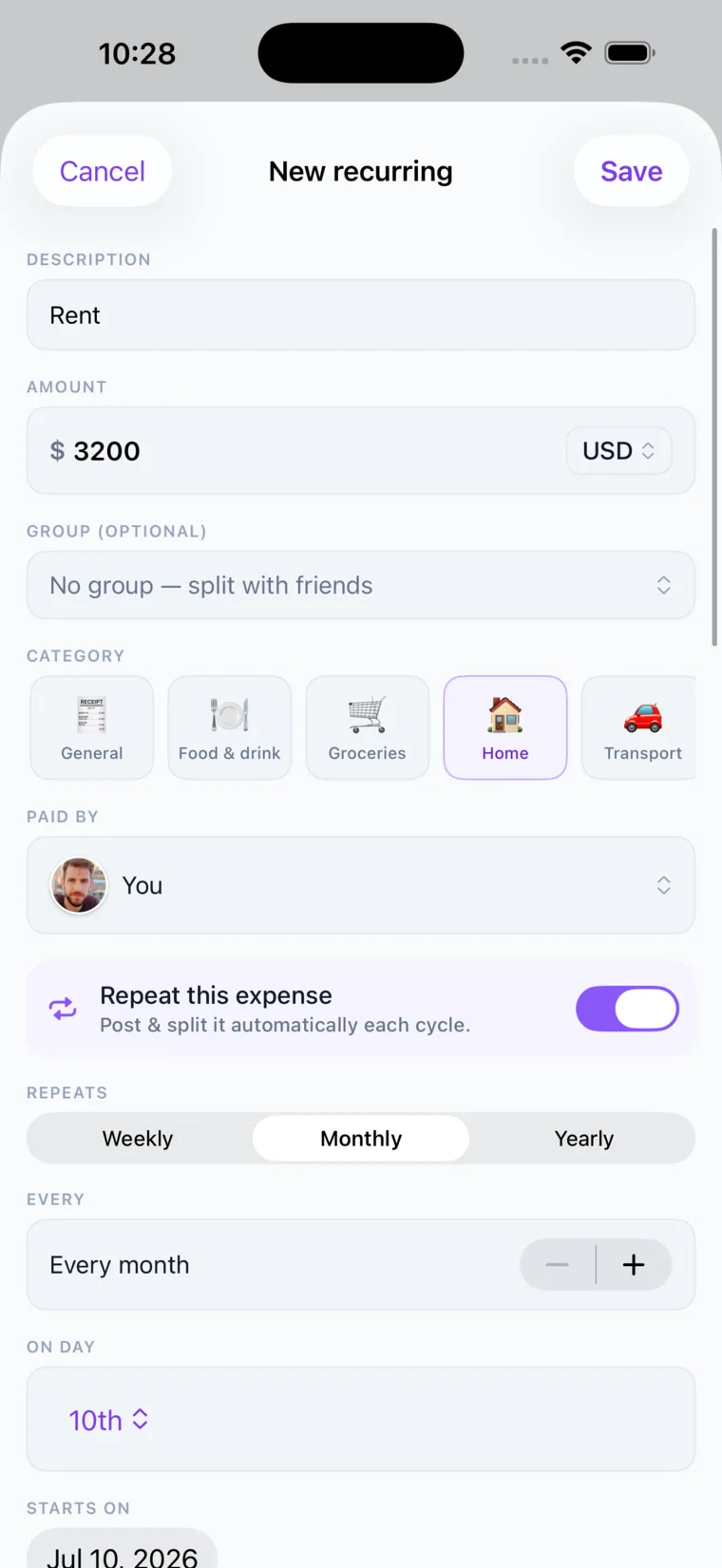
How do you stop chasing people for utilities every month?
Set each bill up once as a recurring expense on the day it actually charges, and let it post itself. Utilities are the clearest case for automation in a shared house: same people, same split, every month, forever — and yet most households re-do it by hand a dozen times a year.
- Use the real billing date so the charge never feels arbitrary.
- Everyone is notified when it posts, so no one person has to be the announcer.
- Variable amounts are fine. Edit the figure when the bill changes — it applies to future charges and leaves paid months at what you actually paid.
- Month-end works properly. A bill dated the 31st still posts in February, landing on the last day.
Pro Tip: Split the bill-holding, not just the bills. One person takes the internet, another the energy, another the water. Everyone fronts something, nobody fronts everything, and the balances largely cancel out.
What about deposits, setup fees, and the final bill?
Treat connection fees as a shared cost, and any refundable deposit as a loan rather than an expense — it comes back, and it needs to come back to whoever actually paid it.
- Setup and connection fees: shared. One-off costs of turning the house on.
- Refundable deposits: log who paid, split the portions, and unwind it when it is returned.
- The final bill: arrives weeks after everyone leaves. Agree before move-out who pays it and how it is split, or it becomes one person’s problem.
- Someone moving mid-cycle: pro-rate by days and enter it as an exact-amount split.
What if someone is always late paying?
Make the balance visible rather than making the reminder louder. Most late payment on utilities is not refusal, it is that the amount is small, the request is verbal, and there is no record — so it slides.
- Log it the day it charges. A visible balance gets paid; a mental note does not.
- Settle on a rhythm. One monthly payment covering everything beats five requests for $28.
- Do not quietly absorb it. A housemate who never quite pays their share is a pattern, and patterns need one honest conversation rather than eleven resentful ones.
Key takeaways
| Question | Answer |
|---|---|
| Default split | Equal, for every utility. Don’t meter showers. |
| When to deviate | Structural differences only — full-time WFH, AC in one room, long absences. |
| How to record a deviation | Agree the numbers, enter them as an exact-amount split. |
| The chasing problem | Set each bill recurring on its real charge date so it posts and notifies itself. |
| Deposits | A loan, not a cost — track who paid and unwind it on return. |
| Final bill | Agree who pays and how it splits before anyone moves out. |
FAQ
How should roommates split utility bills?
Equally between everyone living there, as the default for electricity, gas, water and internet — consumption in a shared house cannot be meaningfully measured, and trying costs more than the difference. Deviate only for structural differences, and record those as exact amounts.
How do you split utilities when one person works from home?
Agree a larger share for them on heating and electricity — the bills they actually affect — and leave internet and water equal. Work out the figures between you and enter them as an exact-amount split, which confirms the parts add up to the bill.
How do you stop chasing roommates for bills every month?
Set each bill up as a recurring expense on the day it actually charges, so it posts itself and notifies everyone on the split. Editing the amount when a variable bill changes applies to future charges only, leaving past months at what you really paid.
Who pays the final utility bill after everyone moves out?
Whoever’s name is on the account will be billed, so agree before move-out how it will be split and settle it when it lands. Pro-rate anyone who left mid-cycle by days and enter it as an exact-amount split.
Is a utility deposit an expense?
No — a refundable deposit is a loan to the provider. Log who paid it and each person’s portion, keep it separate from the monthly bills, and unwind it when the money is returned.
Recommended
- How to Split Rent with Roommates – Call It Even
- How to Split Recurring Bills and Subscriptions – Call It Even
- Splitting Rent and Bills on Different Incomes – Call It Even
- Recurring Expenses – Call It Even