

A nanny share splits one caregiver’s cost between two families, usually landing each family at roughly 60–70% of what they would pay alone — and the arrangement lives or dies on how carefully you write down the money before it starts. This is not a dinner bill. It involves an employee, a schedule, taxes and two households who need to stay friends with each other. Call It Even handles the recurring side so the weekly payment posts itself and neither family becomes the bookkeeper.
How much does a nanny share actually cost each family?
Expect to pay more per family than half the solo rate, because a nanny caring for two families’ children is worth a premium — and expect the total to still be well below two separate nannies or two daycare places. The usual shape is a higher combined hourly rate, split evenly.
| Arrangement | Typical hourly | Cost per family |
|---|---|---|
| One family, one nanny | $25/hr | $25/hr |
| Two families sharing | $32–$38/hr combined | $16–$19/hr each |
| Saving per family | — | Roughly 25–35% |
Rates vary enormously by city, so treat the shape rather than the figures as the point: the nanny earns meaningfully more, and both families still pay meaningfully less.
Should a nanny share be split 50/50?
Yes, as the default, even when one family has two children and the other has one — the nanny’s hours are the cost, and both families are buying the same hours. Departing from even makes sense only when the families are buying genuinely different amounts of care.
- Same hours, same days: split evenly, regardless of how many children each family has.
- One family uses extra days: they pay the full rate for the days they use alone, plus their half of the shared days.
- Three children versus one: some families add a modest differential; many don’t. Decide before you start, not in month four.
- Uneven arrangements are fine as long as they are written down — enter each family’s figure as an exact amount, or agree a percentage split, so the record matches what you agreed.
Who is the employer, and who handles taxes?
Both families usually are, and this is the part people skip. In the US a nanny is generally a household employee rather than a contractor, and in a share each family typically handles its own payroll, taxes and any required insurance for its portion of the wage.
- Each family runs its own payroll for its share, which keeps the tax position clean if one family leaves.
- Agree who buys what insurance, including anything your homeowner’s policy requires for an employee in the home.
- Get the arrangement in writing — hours, rate, location, holidays, sick pay, notice period, and what happens when a family leaves.
- Talk to an accountant. This article is about splitting the cost, not about tax advice, and the rules differ by state and country.
Pro Tip: Write down the exit terms at the start, when everyone is optimistic. The most expensive moment in a nanny share is the month after one family moves, and the only families who handle it calmly are the ones who agreed the notice period before they needed it.
What gets split besides the wage?
More than families expect. The wage is the obvious cost; the running costs of two toddlers in someone’s house are the ones that quietly accumulate on whoever hosts.
- Shared supplies: wipes, snacks, craft materials, sunscreen. Split evenly and log them as they’re bought.
- Activities and classes the nanny takes both children to.
- Mileage if the nanny drives, at whatever rate you agree.
- Bonuses and holiday pay, which should be agreed jointly rather than sprung on one family.
- The hosting cost — if the share always happens at one house, the other family often covers more of the supplies to balance it.
What happens when one family is on holiday or sick?
The nanny is paid for the scheduled hours regardless, and the family that is away normally still pays their share — otherwise the job becomes unpredictable income and you will lose a good caregiver. Decide this explicitly, because it is the single most common source of friction in a share.
The standard arrangement: guaranteed hours are guaranteed. A family that takes a week away pays their half of that week, and a nanny who is sick is covered by whatever paid sick leave you agreed.
How do you keep the money side from becoming a chore?
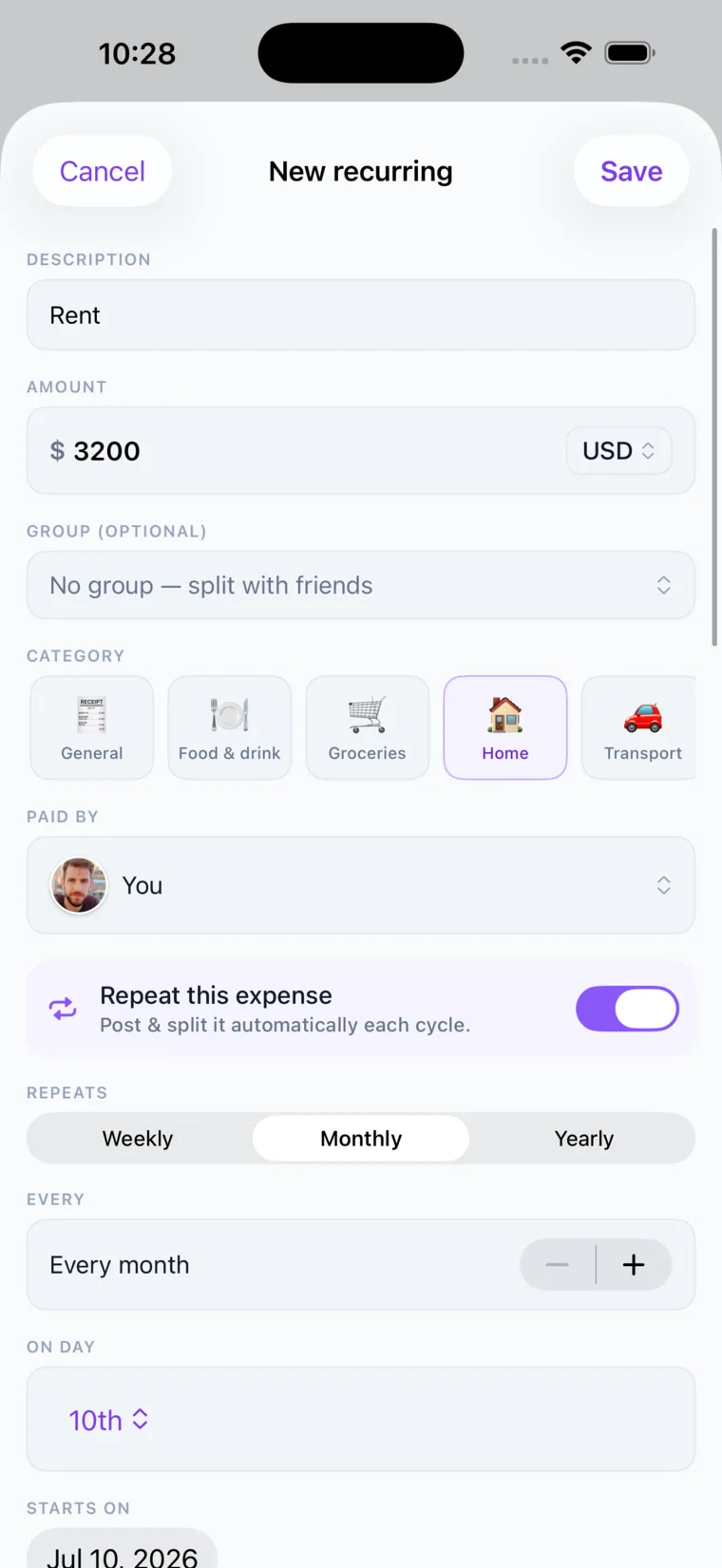
Set the payment up once as a recurring expense on the day it actually happens, and let it post itself every week. A nanny share generates roughly fifty payments a year between two families — precisely the pattern that gets forgotten, delayed and eventually resented.
- Recurring weekly expense on the real payday, split between the two families.
- Both families see the same running balance, so there is no reconstructing anything.
- Log supplies as they’re bought, which stops the hosting family absorbing them silently.
- Settle monthly rather than weekly — one payment instead of four.
Call It Even makes a nanny share simple: set the weekly cost to recur, log the shared supplies as they come up, and settle once a month with both families looking at the same number. Get Call It Even free on iPhone, Android and the web.
Key takeaways
| Question | Answer |
|---|---|
| Typical saving | Roughly 25–35% per family versus a solo nanny. |
| Default split | 50/50, even with different numbers of children. |
| Extra days | Full rate for solo days, half for shared days. |
| Employment | Usually a household employee; each family runs its own payroll. |
| Holidays | Guaranteed hours stay guaranteed — the absent family still pays. |
| Admin | Make the weekly payment recurring and settle monthly. |
FAQ
How do you split the cost of a nanny share between two families?
Evenly on the shared days, as the default, because both families are buying the same hours of care. A family using extra days pays the full rate for those days on top of its half of the shared ones.
Should the family with more children pay more in a nanny share?
Not automatically. The nanny’s hours are the cost, and the combined rate already reflects caring for more than one family’s children. Some families agree a modest differential anyway — the important thing is deciding it before the share starts rather than in month four.
Who is the employer in a nanny share?
Typically both families, each running payroll for its own share of the wage. That keeps the tax position clean if one family leaves. Rules differ by state and country, so check with an accountant rather than copying another family’s arrangement.
Does a family still pay when they’re away on holiday?
Usually yes. Guaranteed hours are what make the job viable for the caregiver, so the standard arrangement is that an absent family still pays its share for the scheduled week. Agree this explicitly — it is the most common source of friction in a share.
What costs besides the wage should be split?
Shared supplies, activities and classes, any agreed mileage, and bonuses or holiday pay. If the share always happens at one family’s house, the other family often covers more of the supplies to balance the hosting.
Recommended
- How to Split Recurring Bills and Subscriptions – Call It Even
- How to Split a Shared Family Plan – Call It Even
- Splitting Rent and Bills on Different Incomes – Call It Even
- Recurring Expenses – Call It Even