

Couples split expenses fairly by agreeing on a method up front — 50/50, proportional to income, or dividing bills by who covers what — and then keeping shared costs in one place while personal spending stays personal. There is no single “correct” way; the fair way is the one you both agree feels even and can actually keep up with. Call It Even makes the follow-through easy: a private shared ledger where you log only the expenses you split, choose how each one divides, and see who owes whom at a glance — without moving money or handing your bank details to an app.
How do couples split expenses fairly?
Couples split expenses fairly by picking a shared method, applying it to joint costs, and leaving individual purchases out of the pool. Fairness comes from the agreement, not from splitting every single thing down the middle.
There are three methods most couples land on, each “fair” under different circumstances:
- 50/50 (equal). Every shared cost splits down the middle. Simplest to run, and it feels right when both partners earn similar incomes.
- Proportional to income (percentage). Each partner covers a share of joint costs equal to their share of the combined income. The higher earner pays more, so both feel the same relative pinch.
- Each covers certain bills. One partner takes rent, the other takes groceries and utilities, roughly balancing to a fair total. Low-effort once the assignments settle.
The healthiest setups usually mix methods — a percentage split on the big recurring bills, an even split on a dinner out, and personal money that nobody has to explain. The point is a system you both understand, not perfection on every transaction.
What’s the difference between shared and personal expenses?
A shared expense is a cost that benefits both partners — rent, groceries, the electric bill, a joint trip — while a personal expense benefits only one person and comes out of their own money. Keeping the two apart is the single biggest thing that keeps money from becoming a fight.
Shared spending goes in the joint pool and gets split by your chosen method. Personal spending — a solo hobby, your own clothes, lunch with a friend, a gift for your partner — stays off the shared ledger completely. You do not need a joint bank account; you only need agreement on which bucket each cost falls into.
A light rule of thumb: if you would have paid for it whether or not you were together, it is probably personal. If it exists because you share a life or a household, it is probably shared. Settle the handful of gray-area categories once and you stop relitigating them every month.
What’s the fairest way to split bills as a couple?
The fairest way to split bills as a couple depends on how close your incomes are: an even split is fair when you earn about the same, and a proportional split is fairer when one partner earns significantly more. Neither is universally “right” — they solve different problems.
Here is how the three common methods compare:
| Method | How it works | Best when | Watch out for |
|---|---|---|---|
| 50/50 (equal) | Every shared cost splits in half | Incomes are similar | Can strain the lower earner |
| Proportional (percentage) | Each pays their share of combined income | Incomes differ a lot | Requires sharing income figures |
| Assign bills | Each partner owns certain bills | You want low day-to-day effort | Amounts drift out of balance over time |
To run a proportional split, add both incomes, then divide each partner’s income by that total to get their percentage. If one earns $4,000 a month and the other $2,000, the combined income is $6,000 — so the higher earner covers about 67 percent of shared costs and the other covers 33 percent. On $3,000 of joint bills that is roughly $2,000 and $1,000, not $1,500 each. Both partners give up the same slice of what they earn, which is what makes it feel even.
Pro Tip: Recalculate your percentages when either income changes — a raise, a new job, or a leave. A split that was fair last year quietly stops being fair the moment the income gap moves.
How do you handle recurring bills like rent and subscriptions?
You handle recurring bills by logging them once as a repeating expense so they post automatically each cycle, instead of re-entering rent and subscriptions by hand every month. This is where most couples’ tracking quietly falls apart — the manual entry gets skipped, and the ledger drifts from reality.
Recurring costs are the backbone of a shared budget: rent or mortgage, utilities, internet, streaming and other subscriptions, insurance. Because they repeat on a schedule, they are perfect candidates to automate:
- List every repeating shared bill and its amount and cycle (monthly, weekly, annual).
- Set the split once — even or proportional — so it applies every time the bill posts.
- Let it auto-post and notify you, so the expense lands on the shared ledger on schedule without anyone remembering to add it.
- Review periodically and cancel subscriptions nobody uses — a quick shared audit that usually pays for itself.
Call It Even’s recurring expenses do exactly this: you set up rent or a subscription once, pick how it splits, and it auto-posts and notifies both of you each cycle. The running total stays current whether or not anyone thinks about it.
Should couples keep a shared ledger?
Yes — a light shared ledger is worth keeping because it replaces fuzzy memory with a clear record of who paid for what, which removes the exact ambiguity that turns money into an argument. The key word is light: a ledger for the shared stuff only, not surveillance of every dollar either of you spends.
A good shared ledger does a few quiet things well:
- It keeps shared and personal separate by only holding the expenses you actually split — personal purchases never appear.
- It stays private between the two of you, not posted anywhere or tied to your bank.
- It tracks balances, not transfers. It records that one of you covered groceries so the other owes half; it never touches your money.
- It lets you settle up on your own terms — when you settle, the recorded payback zeroes the balance and you carry on.
The goal is not to account for every latte. It is to make the shared money boring and predictable, so the relationship is about everything except who paid for the internet.
You can layer any budgeting philosophy on top of a ledger; a personal budget handles each partner’s own money, while the shared ledger handles the overlap. The two coexist neatly.
How do you split expenses without fighting about money?
You avoid money fights by agreeing on the method before the bills arrive, keeping personal spending private, and letting a neutral record settle who owes what instead of relying on memory. Most arguments are not about the amounts — they are about surprise and the feeling of being unheard.
A few practical habits do most of the work:
- Decide the method together and revisit it when life changes, so nobody feels a split was imposed.
- Protect personal money. Each partner having spending that needs no justification prevents a lot of low-grade resentment.
- Log shared costs as they happen, while it is fresh, so the ledger is a fact you both trust rather than a debate.
- Settle on a rhythm — monthly, or whenever balances build up — rather than chasing every small amount.
When the shared money is transparent and the personal money is respected, the two of you have far less to negotiate.
Call It Even makes splitting couple expenses effortless
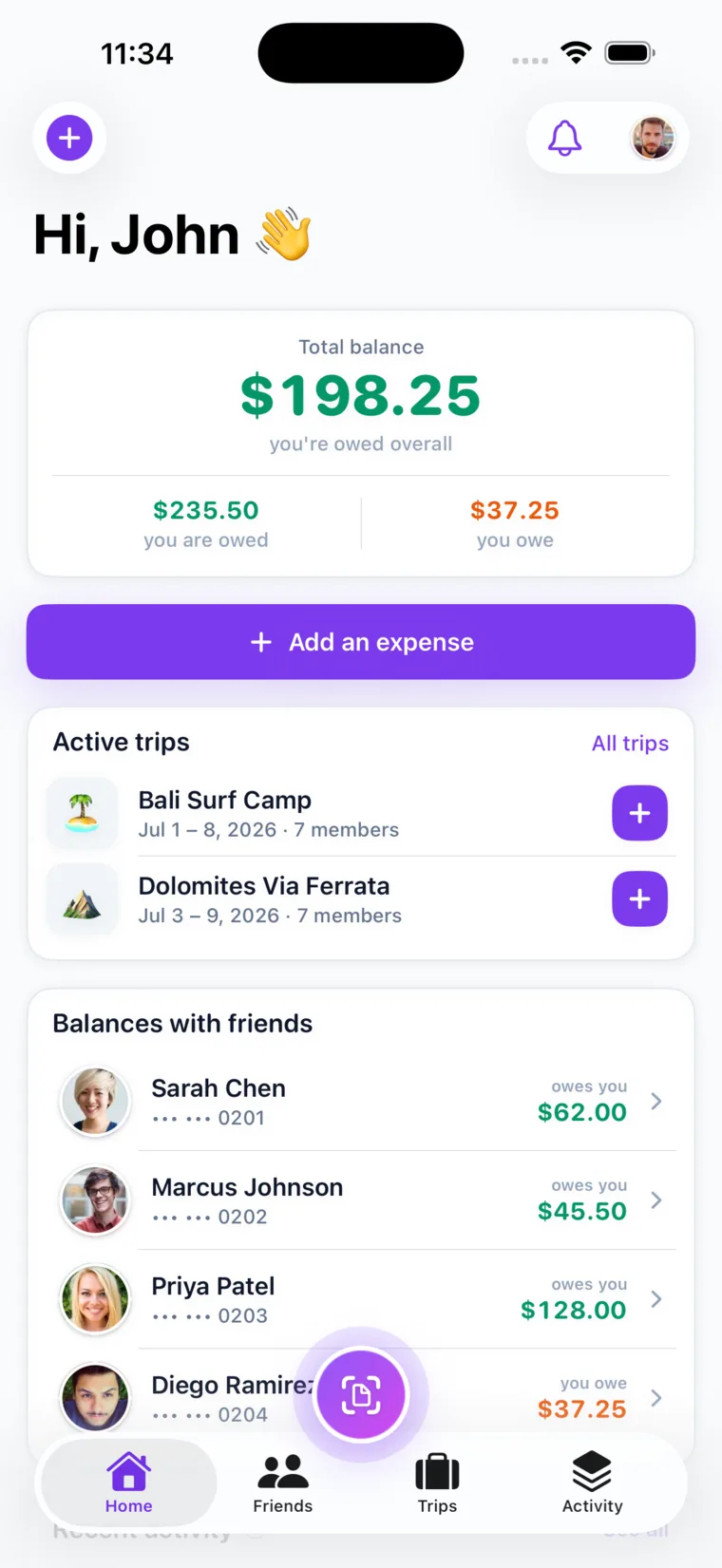
Call It Even is built for two people sharing a life without merging every dollar. Add only the expenses you split, choose how each one divides — equal, exact amounts, or a percentage for proportional-to-income fairness — and the app keeps a private running balance of who owes whom.
Recurring bills like rent and subscriptions auto-post and notify you each cycle, so the shared ledger never falls behind. There are no fees, no bank details, and no money ever leaves your accounts — Call It Even tracks the balance and you settle up however you already do. Get Call It Even and keep the shared costs even and the personal ones personal.
Key takeaways
Splitting expenses fairly as a couple is about agreeing on a method and keeping shared and personal money in their own lanes.
| Point | Details |
|---|---|
| Pick a method together | 50/50, proportional to income, or assigned bills — whatever you both find fair. |
| Split by income when it’s uneven | A percentage split makes each partner give up the same relative slice of what they earn. |
| Keep personal spending personal | Only shared costs go on the ledger; solo purchases never appear. |
| Automate the recurring bills | Set rent and subscriptions to auto-post so tracking never falls behind. |
| Settle from a running balance | Let a private ledger track who owes what, then settle up on your own rhythm. |
FAQ
How should couples split bills if one earns more?
Split proportionally to income. Add both incomes, find each partner’s percentage of the total, and have each cover that share of joint costs. The higher earner pays more in dollars, but both give up the same slice of what they earn, which most couples find fairer than an even split when incomes differ.
Is it better to split everything 50/50 or by income?
It depends on your incomes. A 50/50 split is simplest and feels fair when you earn about the same. A proportional split is fairer when there is a meaningful income gap, because an even split can strain the lower earner. Many couples use a percentage split on big bills and even splits on small shared costs.
Do couples need a joint bank account to split expenses?
No. You can split expenses fairly with entirely separate accounts by tracking shared costs on a shared ledger and settling the balance periodically. Call It Even keeps that ledger without any bank details and never moves money, so a joint account is optional, not required.
How do you keep personal spending out of the split?
Only add the expenses you actually share. A shared ledger holds joint costs like rent and groceries; anything personal — solo hobbies, individual purchases, gifts — simply never gets logged, so it stays private and out of the balance.
How do you handle shared recurring bills?
Set them up once as recurring expenses so they post automatically each cycle with your chosen split. That way rent, utilities, and subscriptions land on the shared ledger on schedule and notify both partners, instead of relying on someone to re-enter them every month.
Recommended
- Splitting Bills – Call It Even
- Fairness – Call It Even
- Budgeting – Call It Even
- Should Friends Split Everything Evenly? – Call It Even
- How to Talk About Money With Friends Without It Getting Weird – Call It Even
- How to Split a Shared Family Plan (Netflix, Spotify, Phone) – Call It Even
- How to Split Pet Costs with Roommates or a Partner – Call It Even
- How to Split a Nanny Share – Call It Even