

The kindest, most reliable way to get friends to pay you back is to keep the amount visible to everyone in a shared ledger, let a neutral app do the reminding, and make paying back a single tap — so nobody has to send an awkward “hey, you still owe me” text. Apps like Call It Even record who fronted what the moment it happens, show the running balance to the whole group, and let people settle up in one move, which quietly removes the discomfort from asking for money back. When the debt is written down where both people can see it, being repaid stops feeling like a favor and starts feeling like housekeeping.
Why do friends forget to pay you back?
Most friends who owe you money have not decided to stiff you — they have simply forgotten, because the debt lives only in your head and not in theirs. When you cover a bill, the amount is vivid to you and invisible to them, so the memory fades within a day or two while your resentment quietly grows.
There are a few predictable reasons repayment slips through the cracks:
- No shared record. If the only evidence is your mental note, the other person has nothing reminding them.
- The amount is fuzzy. “I think I covered your ticket” is easy to defer. An exact number is easy to pay.
- Nobody wants to bring it up. Asking feels petty, so both people wait, and waiting makes it more awkward, not less.
- The payment is inconvenient. If repaying means finding your account details later, “later” never arrives.
The fix for every one of these is the same: get the debt out of your head and into a place you both can see, with an exact figure attached, the moment it happens.
How do you ask a friend for money back politely?
You ask politely by being specific, casual, and unapologetic — name the exact amount, reference what it was for, and keep it short. Vagueness and over-apologizing both make the ask more awkward, not less, because they signal that you think you are imposing.
Compare the two approaches:
| Awkward ask | Clean ask |
|---|---|
| “Sorry to bug you… no rush at all, but do you maybe remember that thing I paid for?” | “Hey! You’re at $32 for the concert tickets whenever you get a chance.” |
| Leaves the amount and the deadline undefined | States the number and makes it effortless |
| Puts the burden of remembering on them | Puts the fact in front of them |
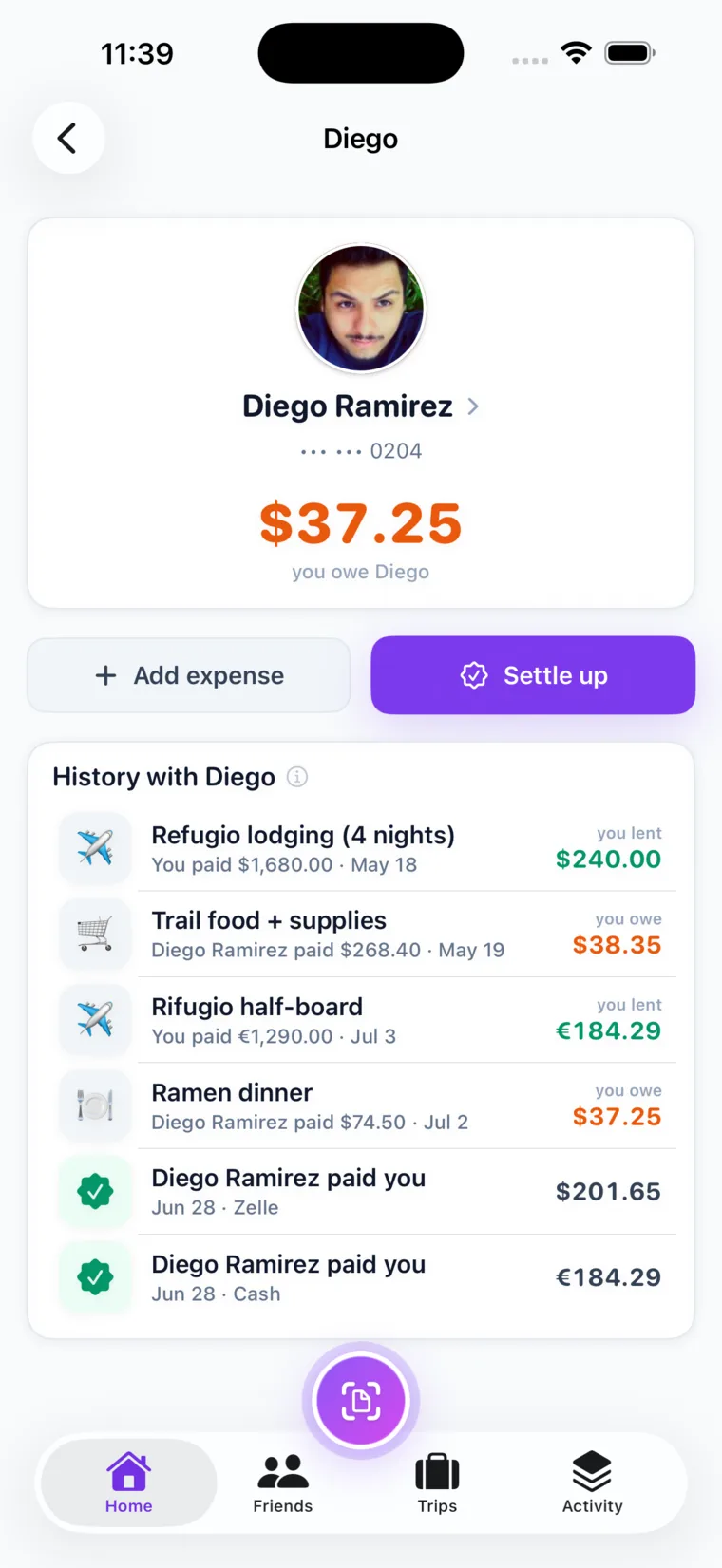
The single most effective move, though, is to not be the one asking at all. When the debt is logged in a shared app, the balance itself does the asking — your friend opens the app, sees “$32,” and pays. You stay the friend, not the debt collector. That is the whole reason a neutral ledger disarms the awkwardness: nobody has to play bad cop.
How do you get paid back after covering the bill?
The reliable way to get paid back after fronting a group bill is to record the expense before you leave the table, split it, and let each person see their share immediately — while the meal is fresh and everyone’s wallet is still out. Repayment is easiest in the first five minutes and hardest a week later.
The sequence that works:
- Log it on the spot. Enter the total, or scan the receipt, before the memory of who ordered what fades.
- Split it fairly. Divide evenly, by item, or by exact amounts — whatever matches what actually happened.
- Let everyone see their number. Each person now has an exact figure, not a rough guess.
- Point them to a repayment method. Cash, Venmo, or a bank transfer — you settle however you already do.
Call It Even is a ledger, not a bank: it never touches your money or asks for bank details. It records that you paid, shows everyone their share in a balance the whole group can see, and then gets out of the way while people pay each other back however is convenient. The transparency is the mechanism — when the number is public and precise, it gets paid.
Pro Tip: Log the expense before you stand up from the table. The five minutes right after the bill lands is the highest-repayment window you will ever get — waiting until the next day is where debts go to die.
What if a friend still won’t pay you back?
If a friend still won’t pay after the amount is visible and reminders have gone out, the problem is no longer memory — it is either awkwardness about the method or genuine reluctance, and each has a different fix. Start by assuming the friendlier explanation.
- Make paying trivially easy. Send your payment handle directly so there is zero friction. Often the holdup is nothing more than “I didn’t have your details handy.”
- Offer a smaller step. “Want to just get the $40 and we’ll call it even?” gives a reluctant payer an easy exit.
- Let the shared balance stand. With a visible ledger you do not need to re-ask; the running total carries the debt until they settle, without a single nagging text from you.
- Say it plainly, once. For a persistent case, a direct, warm “hey, can you square up the $40 this week?” is fairer to the friendship than silent resentment.
A friendship rarely ends over a repaid debt. It sours over an unspoken one that festers because nobody wrote it down. The visible ledger protects the relationship precisely by making the money boring and factual instead of personal.
How does a shared balance make repayment easier?
A shared, real-time balance makes repayment easier because it converts a private grievance into a mutual fact — both people are looking at the same number, so there is nothing to dispute and nothing to feel sheepish about. Transparency removes awkwardness by removing ambiguity.
When everyone can see the ledger, several good things happen at once:
- No one can honestly forget. The balance is right there every time the app opens.
- No one feels singled out. The app shows the number, so you are never the person nagging.
- Settling is one action. When someone pays you back, you record the payback and the balance resets to zero — clean slate, no lingering “did they get me back?”
Notifications quietly reinforce all of this: when you add an expense or someone settles up, the group gets a gentle nudge, so activity stays top of mind without anyone having to chase.
The goal was never to collect a debt. It was to make the money so visible and so easy that repayment happens on its own — and the friendship never has to notice.
Call It Even makes getting paid back effortless
Call It Even is built for exactly this: you front the money, the app writes it down where everyone can see it, and your friends pay you back without you ever having to send an awkward text. Log an expense in seconds — or scan the receipt — split it however is fair, and the whole group sees a live balance of who owes whom.
There are no fees, no bank details, and no chasing — Call It Even keeps the ledger while you and your friends settle up however you already do, then record the payback and the balance resets to zero. It also handles group expenses, trips, multiple currencies, recurring bills, and friends who aren’t on the app yet. Get Call It Even and let the balance do the asking for you.
Key takeaways
Getting friends to pay you back is less about how you ask and more about making the debt visible, exact, and easy to clear.
| Point | Details |
|---|---|
| Write it down immediately | Log the expense on the spot so it lives in a shared record, not just your memory. |
| Make the number exact | A precise amount gets paid; a vague “you owe me something” gets deferred. |
| Let the app do the asking | A visible balance and gentle reminders mean you never have to be the debt collector. |
| Make paying frictionless | Share your handle and settle however people already pay — cash, Venmo, or transfer. |
| Settle in one move | Record the payback and the balance resets to zero, leaving no lingering question. |
FAQ
How do you remind a friend to pay you back without being annoying?
Let a neutral app send the reminder instead of you. When the debt is logged in a shared ledger, the balance and its notifications do the nudging, so your friend sees the exact amount without you having to send a single “you still owe me” text.
What do you say to a friend who owes you money?
Keep it short, specific, and free of apology: name the amount and what it was for, like “you’re at $25 for the tickets whenever you’re ready.” Specific and casual reads as normal housekeeping; vague and over-apologetic reads as awkward.
Is it rude to ask a friend to pay you back?
No. Asking to be repaid for money you fronted is completely reasonable — what feels rude is the ambiguity, not the request. Using a shared balance makes the ask impersonal and factual, so nobody feels singled out and the friendship stays intact.
How do you track who owes you money?
Use an app that keeps a running, shared balance so every expense and payment is logged automatically. Call It Even records each cost you cover, shows the whole group who owes whom in real time, and keeps an activity timeline of every expense and payback — for free, with no bank details.
What is the best way to settle up with friends?
Let the debts accumulate in one ledger and settle once, rather than paying back after every coffee. When someone repays you, record the payback in the app and the balance resets to zero, so both of you have a clean, unambiguous record that you are square.
Recommended
- Getting Paid Back – Call It Even
- Settling Up – Call It Even
- Group Expenses – Call It Even
- What to Do When a Roommate Won't Pay Their Share – Call It Even
- How to Talk About Money With Friends Without It Getting Weird – Call It Even
- How Group Debt Tracking Works for Small Groups – Call It Even
- What Is Mutual Cost Tracking? A Guide for Small Groups – Call It Even
- When Someone Leaves the Group Still Owing Money – Call It Even