

The fair way to split groceries with roommates is to draw one line everybody agrees on — shared staples get split, personal items do not — then log every shop as it happens. Call It Even is built for exactly this: put your household in a Group, let whoever went to the store log the receipt, and each person’s share of the oil, the paper towels, and the milk is tracked automatically, while the $28 tub of protein powder stays on the one person who wanted it.
How do you split groceries with roommates?
You split groceries with roommates by separating shared staples from personal items, dividing only the staples among the house, and logging every trip to a shared ledger so the balance builds as you go. The households that make this work are not the ones with the strictest rules — they are the ones that log the receipt before they unpack the bags.
Groceries are the hardest household cost to split because they are half communal and half personal, and the mix changes every week. Rent is one number; the internet bill is one number. A grocery run is forty numbers, some belonging to everyone and some to one person’s diet. Households that argue about groceries are rarely arguing about money — they argue because nobody agreed where the line is.
What counts as a shared staple and what stays personal?
A shared staple is anything the house uses without anyone tracking who used it — cooking oil, salt, spices, dish soap, paper towels. A personal item is anything bought for one person’s taste, diet, or habit, and it belongs entirely to that person no matter who was holding the card at the register.
| Category | Usually shared | Usually personal |
|---|---|---|
| Pantry basics | Oil, salt, pepper, flour, sugar, spices | The $22 finishing oil one person wanted |
| Cleaning and paper | Dish soap, sponges, paper towels, trash bags | Almost nothing |
| Fridge basics | Milk, eggs, butter, shared condiments | The oat milk only one person drinks |
| Meals and produce | Dinners you cook together | Your own lunches and snacks |
| Drinks | Coffee or tea the house drinks | Alcohol, energy drinks, protein powder |
Write the shared list down once. It ends most grocery arguments, because the question stops being “is this fair?” and becomes “is this on the list?”
Pro Tip: Keep the shared list short and boring. The more items on it, the more often somebody feels they funded someone else’s taste. Oil, spices, soap, and paper goods are cheap and nobody resents them. Anything with a brand preference attached is a personal item waiting to happen.
Should one person do the shopping for the house?
Yes — one person shopping for the household staples is the most efficient pattern by far, as long as they log the receipt and get paid back on a predictable rhythm. One trip beats three, and it is the only reliable way to stop ending up with three open jars of mustard.
The pattern fails in one way: the shopper quietly becomes the household’s bank. They front $90 of staples, nobody remembers, and three weeks later they are $200 down and resentful — not because their roommates are dishonest, but because nothing was written down.
- Rotate the trip, not the tab. Take turns going, and log every trip either way.
- Log it before you unpack. Grocery money goes untracked because the bags come in first and the receipt ends up in the trash.
- When in doubt, make it personal. Nobody should make judgment calls with other people’s money.
How do you split a grocery receipt when half of it is personal?
You split a mixed receipt by assigning each line to whoever it was for — the staples divide among the house, each personal item goes entirely to the person who wanted it, and the tax follows each person’s item subtotal instead of being split evenly.
Here is the real shape of a shop. Three roommates, $136.00 of items plus $10.88 of tax, $146.88 on the card. Of that, $96.00 is shared staples, $28.00 is Alex’s protein powder and oat milk, and $12.00 is Sam’s snacks. Jordan bought nothing personal.
| Person | Share of the $96 staples | Personal items | Tax (proportional) | Owes |
|---|---|---|---|---|
| Alex | $32.00 | $28.00 | $4.80 | $64.80 |
| Sam | $32.00 | $12.00 | $3.52 | $47.52 |
| Jordan | $32.00 | — | $2.56 | $34.56 |
Split that receipt evenly and everyone pays $48.96: Jordan just paid $14.40 toward food he did not eat, and Alex’s protein powder collected a $15.84 subsidy. Note the tax, too — Alex’s items are 44 percent of the subtotal, so he carries 44 percent of the tax. Split it evenly instead and you undo much of the fairness you just built.
How do you itemize a grocery receipt without doing it by hand?
You point your phone at it. Call It Even’s receipt scanning uses AI to read every line off the printed receipt, you drag each item onto whoever it was for, and the tax splits in proportion to each person’s item subtotal automatically — a forty-line grocery receipt becomes an itemized, logged expense in about a minute.
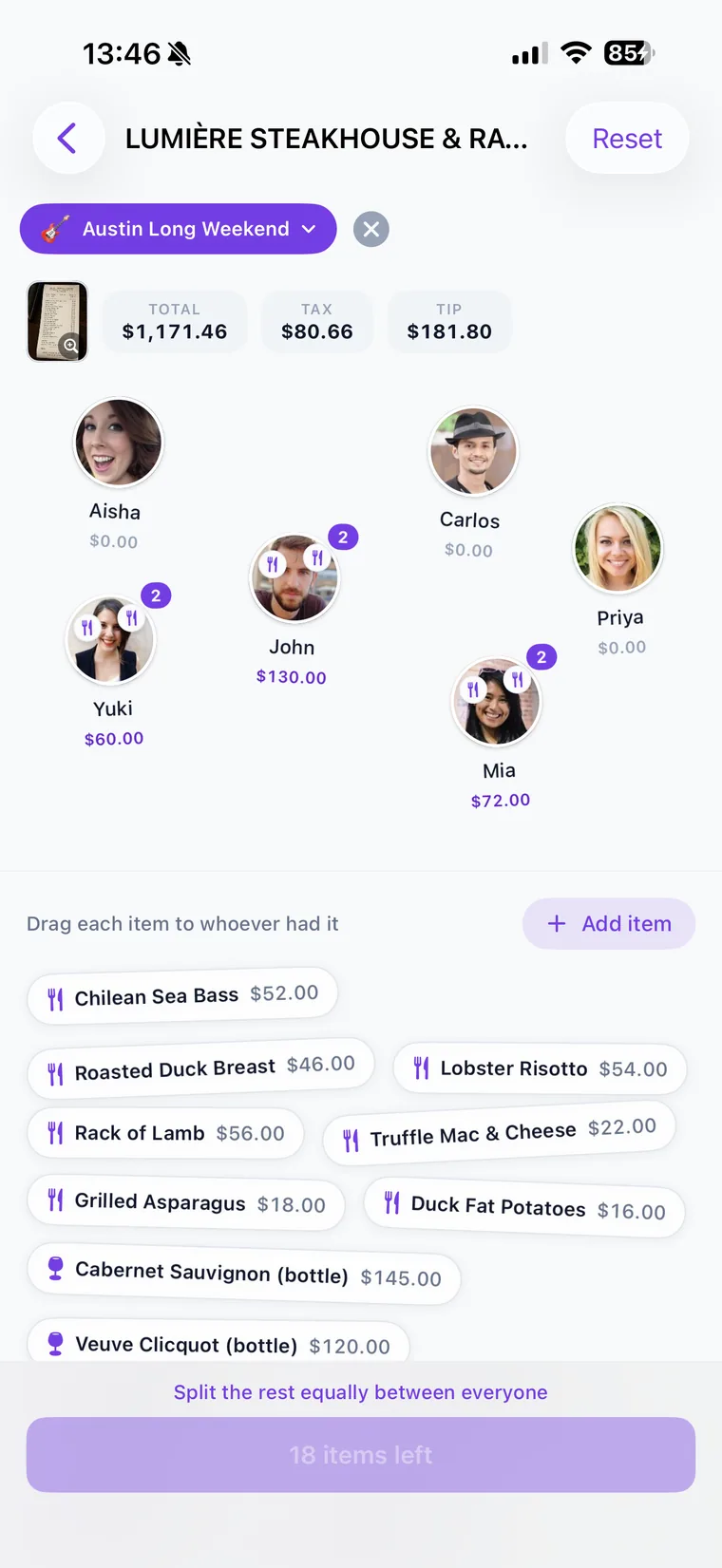
Groceries are the best case for scanning because they are the worst case for doing by hand. A restaurant check has eight lines; a weekly shop has forty, half printed as things like “GV SHRD MOZZ 8Z”, and the person holding it is standing in a kitchen with cold food in a bag — exactly when good intentions become “ugh, just split it.”
Scanning comes with a free monthly allowance: verify your email for two free scans a month, verify your phone for three more, and they stack to five — about one weekly shop. They reset each month rather than banking up. Once used, itemizing by hand works the same way: enter the amounts and split them as exact amounts, the same move that works on a restaurant bill split by item.
Should you run a household tab or settle up every week?
Run a tab. Paying each other back after every shop is several transactions a week nobody wants to make, while a running tab lets expenses accumulate into one balance with each roommate — most households settle when rent is due, because the money is already moving that day.
A tab also self-corrects. When you rotate who shops, your balance with each roommate drifts up when they go and back down when you go. Over a month of taking turns most of it cancels out, and what is left is the residue of uneven turns.
Settle on a fixed day — rent day is the natural anchor, and it pairs with the recurring bills you already split monthly — or when the balance crosses a number that would bother you. Never let it run past a month.
Call It Even is a ledger, not a bank: it never holds, moves, or requests money. You pay your roommate however you already do, then record it, which resets the balance to zero.
What do you do when roommates eat different amounts?
First check whether they actually eat more or just eat differently — usually it is a category problem, not an appetite problem, and the fix is moving one item from the shared list to personal rather than renegotiating the whole split. If it is genuinely appetite, agree each person’s figure and enter it as an exact-amount split.
- Move the contested item to personal. If one person drinks all the oat milk, oat milk is personal.
- Shrink the shared list to true staples. Oil, spices, soap, paper goods: cheap enough that appetite differences are noise.
- Agree an uneven figure, once. If an imbalance survives both, settle it in one conversation, not every Sunday.
The third option needs spelling out, because it is where people expect an app to do something clever. Call It Even splits an expense equally or by exact amounts. So you agree it out loud — say the two who cook every night carry 40 percent each of the shared food and the one who mostly eats out carries 20 — then work the figures out once and enter them: on $120, that is $48, $48, and $24. The app checks they add up to the total to the cent.
That is the free-rider problem in miniature: nobody blows up over $4 of milk; they blow up over having felt, for six months, like the only person who ever buys it.
Call It Even makes splitting groceries simple
Call It Even is built for this exact problem: a shared fridge, one person at the store, and a receipt that is half everybody’s and half one person’s. Put your house in a Group, and every shop gets logged by whoever went — scanned from the receipt with each item dragged to its owner, or entered by hand as an equal or exact-amount split.
From there the ledger keeps a running balance with each roommate across groceries, rent, and every shared bill, and you settle up on whatever rhythm suits the house. It is free forever — no ads, no fees, no bank details — and live on iOS, Android, and the web. Get Call It Even and settle the grocery question for good.
Key takeaways
Splitting groceries fairly is mostly about drawing the line once and logging the receipt every time.
| Point | Details |
|---|---|
| Draw the line once | Shared staples get split; personal items sit on whoever wanted them. Keep the list short. |
| One shopper, logged every time | One trip beats three — if the receipt is logged before the bags are unpacked. |
| Itemize the mixed receipts | Scan it, drag each item to its owner, and let tax follow each person’s item subtotal. |
| Run a tab, settle on a rhythm | Balances self-correct as you rotate the shop. Settle on rent day, never past a month. |
| Uneven eaters get a figure, not a fight | Move the item to personal first; if an imbalance remains, agree each person’s amount and enter it as an exact-amount split. |
FAQ
How do you split groceries with roommates fairly?
Split only the shared staples — oil, spices, soap, paper goods, and fridge basics the whole house uses — and leave personal items on whoever wanted them. Log every shop as an expense paid by whoever went, so a running balance builds, then settle up on a rhythm.
Should roommates split groceries evenly?
Split the true staples equally, but not a whole mixed receipt. Splitting everything evenly means the person who bought nothing personal subsidizes the person who did — on a typical $147 shop, that is $14 wrong in one trip. Itemize the receipts with personal items on them.
How do you split a grocery receipt when some items are personal?
Assign each line to whoever it was for: the staples divide among the house, each personal item goes entirely to the person who wanted it, and the tax splits in proportion to each person’s item subtotal rather than evenly. Call It Even’s receipt scanning reads the lines with AI, so you drag each item to its owner.
Should roommates settle grocery costs after every shop or run a tab?
Run a tab. Paying back after every trip is several small transactions nobody wants to make, and when you rotate who shops the balances largely cancel out. Settle on a fixed day — rent day works well — or when the balance crosses an amount that would bother you.
Is Call It Even free for splitting groceries with roommates?
Yes. Call It Even is free forever, with no ads or fees, and it never asks for bank details. Receipt scanning has a free monthly allowance — two scans for verifying your email plus three for verifying your phone, five in all. It is a ledger, not a bank: it records who owes whom and you pay each other as you already do.
Recommended
- How to Split Rent With Roommates – Call It Even
- How to Split Recurring Bills and Subscriptions – Call It Even
- Receipt Scanning – Call It Even
- Groups – Call It Even
- How to Split a Tailgate or Game Day Party – Call It Even