

You split expenses with people who are not on the app by adding them as guests: they get a name, they count in every split, and their share is carried by whoever brought them. Nobody has to download anything for the numbers to be right. Call It Even is built around this, because the alternative — refusing to log a dinner until all nine people have signed up — is how a shared ledger dies in its first week.
What happens when not everyone has the app?
Nothing breaks — you add them as a guest and carry on. This is the most common reason people abandon expense tracking altogether: one person installs something, three friends say “just tell me what I owe,” and within two days the app is a private notebook that only one person is keeping.
- Guests are people without accounts. You add them by name and they appear in splits like anyone else.
- Their share belongs to whoever added them. A guest has no account to owe from, so the balance sits with the friend who brought them — which is also how the real world works.
- Nothing is blocked. A group can be entirely guests. The maths is identical.
Who is responsible for a guest’s share?
Whoever brought them. If your partner comes to the group dinner and is not in the app, their portion lands on your balance, not on some floating account nobody can settle. This is deliberate: a debt needs a person who can actually pay it.
| Situation | How to handle it |
|---|---|
| A partner who comes to everything | Add them as a guest once. Their share rolls into yours, which is how you would settle anyway. |
| A friend-of-a-friend on one night | Add as a guest for that expense only. Their share sits with whoever invited them. |
| Someone who will join eventually | Invite them by phone number instead — see below — so their history connects when they sign up. |
| A colleague you will never split with again | Guest. There is no reason to make a one-off dinner into a friendship in an app. |
What is the difference between a guest and an invite?
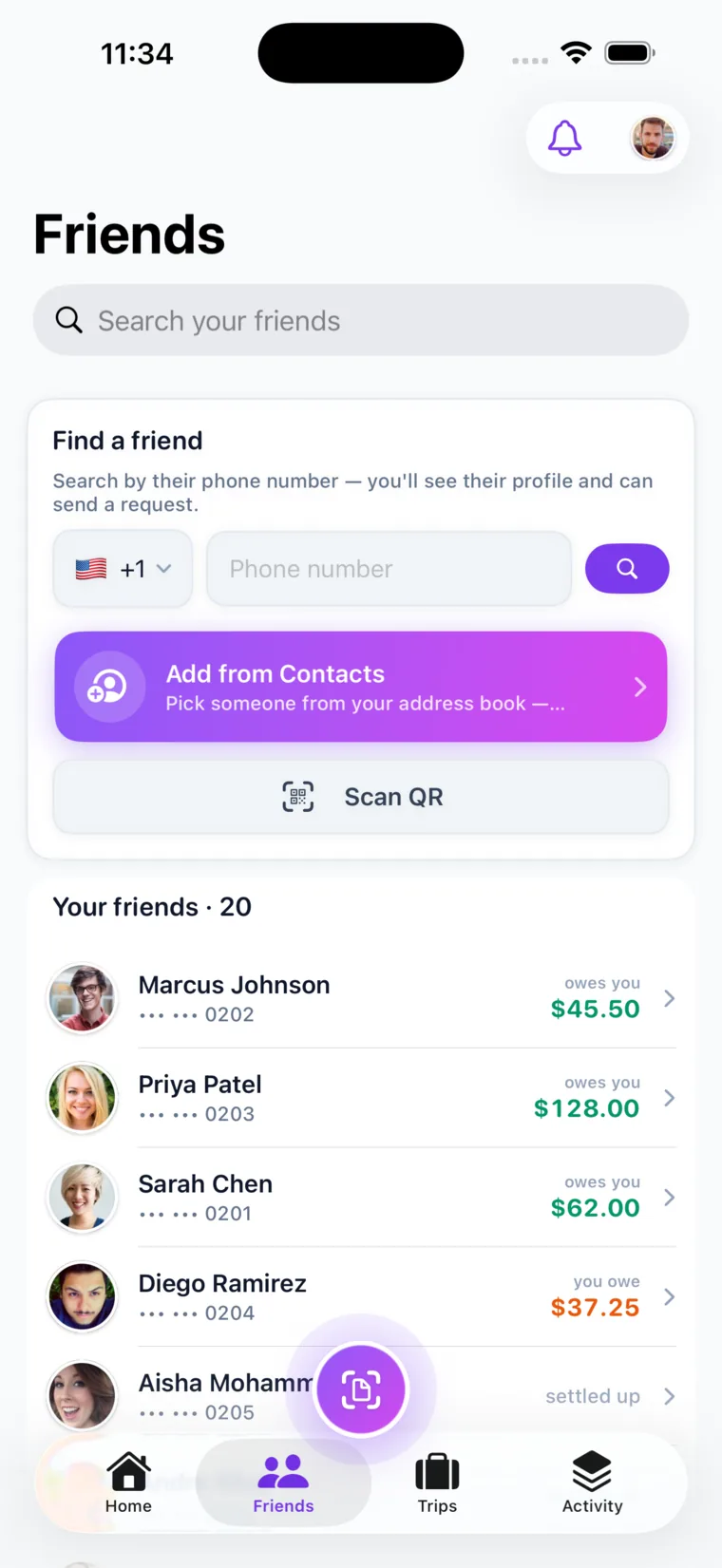
A guest is a name you control; an invite is a placeholder for a real person who may show up later. Both let you split immediately, but they end differently, and picking the right one saves re-entering a month of history.
- Add as a guest when the person will never have an account, or it does not matter — a plus-one, a visiting cousin, a colleague. Their balance stays attached to whoever added them.
- Invite by phone number when they are a genuine, repeat member of the group who just has not signed up yet. They become a provisional friend, they still count in every split, and if they later join with that number their account connects to the history already recorded — nothing to re-enter.
Pro Tip: For anyone you will split with more than twice, invite by phone rather than adding a guest. It costs the same effort today and saves rebuilding a month of expenses the day they finally download it.
How do you show someone what they owe if they have no account?
Send them a share link. It opens a read-only view of the group or the single expense in any browser, with no app and no signup, so they can see every line rather than taking your word for a number.
- It is read-only. They can see the expenses and the split; they cannot change anything.
- No account, no install. It opens in a browser like any web page.
- It expires. Links last three days, so a group’s ledger is not left permanently open on the internet. If someone needs it again, you re-share it.
- It travels well. Paste it in the group chat and the arithmetic answers its own questions.
This is usually the fastest way to end a disagreement. “You owe $34” invites a debate; a link showing a $204 bill split six ways does not.
How do you settle up with someone who is not in the app?
Exactly as you always have — they pay you however you two normally pay each other, and you record it. Call It Even is a ledger, not a bank: it never holds, moves, or requests money, so nothing about settling depends on the other person having installed anything.
- They pay you by Venmo, Zelle, bank transfer, or cash. The app has no opinion about which.
- You record the payment against the balance so it clears.
- For guests, settle with their host. If your friend brought two people, you settle with your friend for all three. One payment, not three.
When should you ask people to join anyway?
When the group is going to keep splitting things — a household, a recurring trip crew, a couple who share bills. Guests are ideal for one-off and edge cases, but they have one real limitation: a guest cannot see the ledger themselves, so you remain the single source of truth for their share.
- Housemates should have accounts. Rent and utilities repeat forever; everyone should see the same numbers.
- Your regular travel group should too. Once a group has two trips of history, guest-keeping becomes real work.
- Everyone else can stay a guest indefinitely. There is no pressure and no expiry.
Pro Tip: Do not make joining the price of entry to the dinner. Log it with guests, send the share link, and let people decide for themselves. Signups that follow a link nearly always stick better than the ones extracted at a table.
Key takeaways
| Need | What to use |
|---|---|
| Split with someone who will never sign up | Add them as a guest — they count in splits, their share sits with whoever brought them. |
| Split with someone who probably will sign up | Invite by phone number; their history connects to their account when they join. |
| Show someone the numbers | A share link — read-only, no account, expires after three days. |
| Get paid by someone not in the app | However you already pay each other, then record it. The app never moves money. |
| A recurring group | Worth everyone having an account so nobody is the sole record-keeper. |
FAQ
Can you split an expense with someone who does not have the app?
Yes. Add them as a guest by name and they count in every split immediately, with no signup and no email required. Their share is carried by whoever added them, so there is always a real person the balance can be settled with.
Who is responsible for a guest’s share?
Whoever added them. A guest has no account to owe from, so their portion sits on the balance of the friend who brought them — which is usually how the group would settle it anyway.
What is the difference between adding a guest and inviting someone by phone?
A guest is a name that stays attached to you; an invited person becomes a provisional friend whose account connects to the recorded history if they sign up with that number later. Use a guest for one-offs and plus-ones, and an invite for anyone you will split with repeatedly.
How can someone see what they owe without installing anything?
Send them a share link: a read-only web view of the group or a single expense that opens in any browser with no account. It expires after three days and can be re-shared if they need it again.
Is it free to split with guests?
Yes. Call It Even is free forever on iPhone, Android, and the web, with no fees and no bank details, and there is no limit on adding guests. It tracks who owes whom and never moves your money.
Recommended
- How to Split a Bar Tab Fairly – Call It Even
- How to Split the Cost of a Group Gift – Call It Even
- Adding Friends & Guests – Call It Even
- Share Links – Call It Even
- How to Split Holiday Travel Costs – Call It Even
- How to Split a Tailgate or Game Day Party – Call It Even