
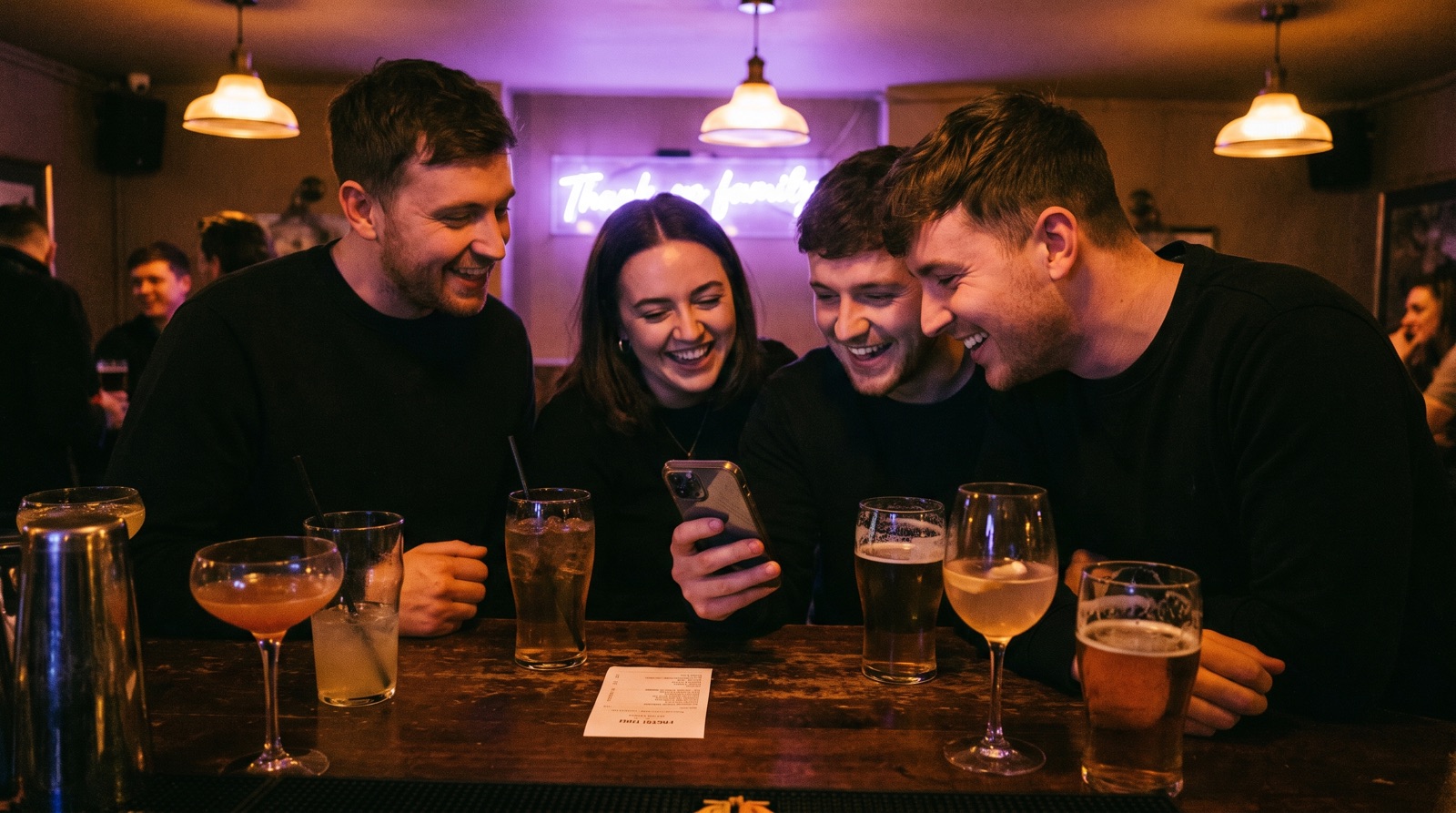
The fairest way to split a bar tab is to itemize it: assign every drink to the person who actually drank it, split the tip and any service charge in proportion to what each person ordered, and settle up before anyone leaves. An even split is the closing-time default only because it is easy, never because it is fair — it charges the friend who nursed two sodas the same as the friend who had five old fashioneds. Call It Even is built for exactly this moment: snap the itemized tab, drag each drink to whoever had it, and everyone’s balance is settled before the bartender closes out the card.
How do you split a bar tab fairly?
You split a bar tab fairly by itemizing it — assigning each drink to the person who ordered it, then dividing tax and tip in proportion to each person’s drink total — rather than dividing the whole tab by headcount. A bar tab is the least even bill you will ever be handed, so it is the bill where an even split does the most damage.
The mechanics of a bar are what make it lopsided. One card goes behind the bar at 8pm because it beats running six cards all night, everyone orders independently for four hours, and at closing you get a single number containing no information about who ordered what. Meanwhile the cardholder is personally on the hook for all of it, a $4 soda and a $19 cocktail sit on the same tab, and people drift in at nine and leave at eleven. The tab does not know any of that. An even split cannot either.
Why is an even split unfair on a bar tab?
An even split is unfair on a bar tab because drink prices and drink counts vary more than on almost any other shared bill, so dividing by headcount silently transfers money from the light drinkers to the heavy ones. The number everyone pays is identical; the value everyone received is not remotely close.
Here is a real-shaped night: five friends, a $240 bar subtotal, and 30% on top for tax and tip, bringing the tab to $312.
| Person | What they drank | Drinks subtotal | Even split | Itemized share |
|---|---|---|---|---|
| Maya | 2 sodas | $12 | $62.40 | $15.60 |
| Dev | 5 cocktails | $80 | $62.40 | $104.00 |
| Priya | 3 beers, 1 shot | $42 | $62.40 | $54.60 |
| Sam | 4 cocktails | $64 | $62.40 | $83.20 |
| Jordan | 3 glasses of wine | $42 | $62.40 | $54.60 |
Maya had $12 of soda and an even split asks her for $62.40. She is not paying for her drinks — she is paying $46.80 toward everyone else’s, while Dev drinks $104 of the tab and pockets a subsidy he never asked for and never noticed. Once, that is a rounding error in a friendship. Every other Friday for a year, and Maya has quietly funded a vacation she did not take — which is roughly when she starts having other plans.
How do you itemize a bar tab off the receipt?
You itemize a bar tab by asking the bartender for the itemized receipt rather than the card slip, then assigning each printed line to whoever ordered it. Most groups skip this because the paper they get by default is the wrong one: the card voucher has a total and a tip line, while the itemized tab lists every drink poured.
Pro Tip: Say “can we get the itemized tab as well?” when you hand over the card, not after. Once the tab is closed and the drawer is shut, re-printing the detail is a favor rather than a routine, and at 1am on a Saturday you will not get it.
Once you have the print, the arithmetic is the easy part. Point your camera at the tab and Call It Even’s AI pulls out every line. On the assign canvas each person is a circle and each drink is a chip — flick a chip onto whoever had it, or tap a shared pitcher to split that one item between the people who poured from it. A button splits whatever is left equally, and you cannot save with a drink unassigned.
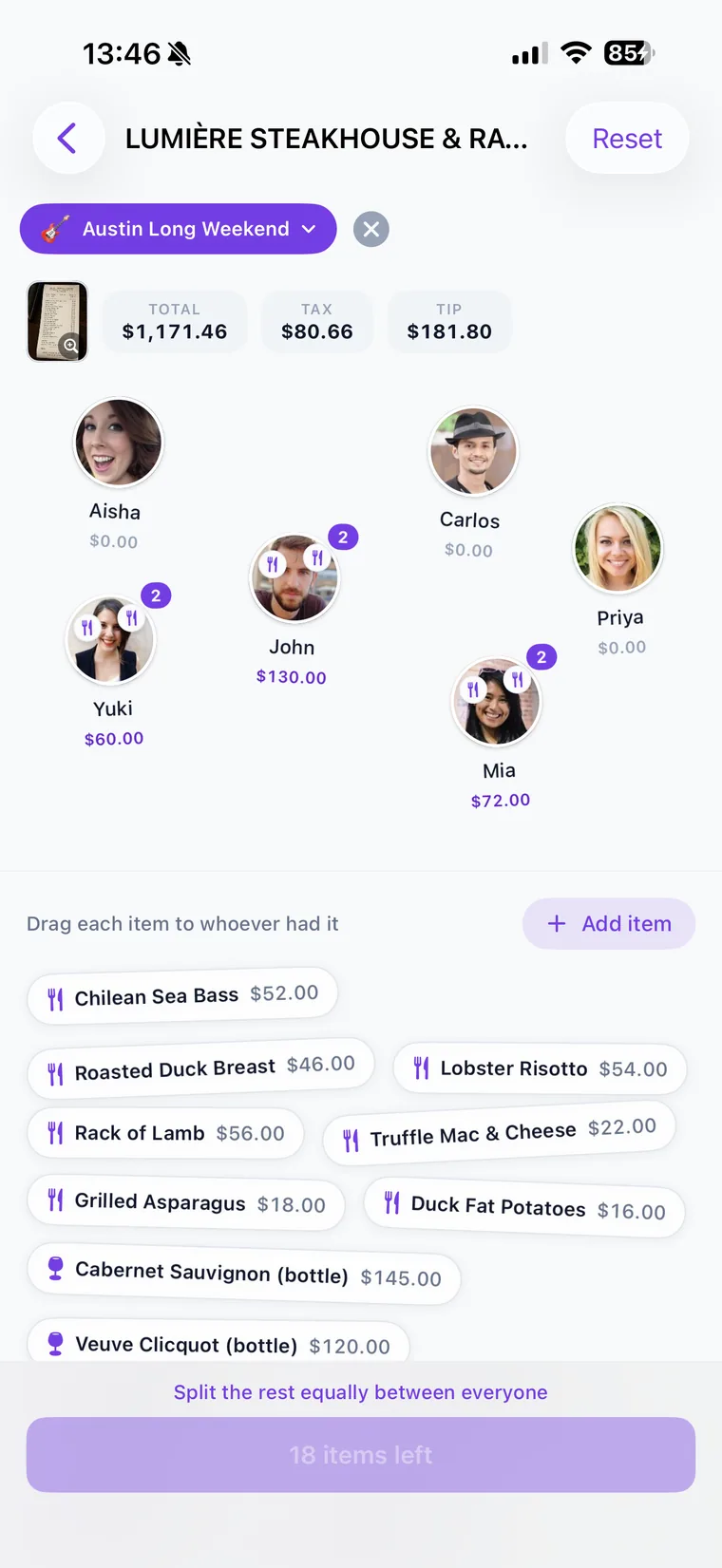
Scanning is free: every account gets monthly scans, 2 for a verified email plus 3 for a verified phone.
How do you handle rounds on a bar tab?
You handle rounds by logging each round as its own expense, paid by whoever bought it and split equally between only the people in that round — never across the whole table. Rounds are not a splitting method; they are an informal loan system assuming everyone drinks the same thing at the same pace and stays to the end. Two of those three fail on a normal night:
- Someone leaves mid-cycle. They were bought two rounds and bought one.
- Rounds are not equal value. A round of well beers costs $28; the next one, once the group has warmed up, costs $76.
- Late arrivals get bought in. They walk into a round already on the bar and leave before the cycle returns to them.
A round only works as a fair split when everyone drinks the same number of drinks at the same price and nobody goes home early. That is not a night out — that is a controlled experiment.
The simplest fix is to ignore rounds and itemize the tab at the end — it does not care who walked to the bar, only what got poured. If your group enjoys rounds, log each one instead: one expense, the buyer as payer, split equally between just its drinkers. Call It Even then keeps a running balance with each friend, so you see who is up and who is down.
How do you split the tip and the service charge on a bar tab?
You split the tip in the same proportion as the drinks — each person’s tip share matching their share of the subtotal — and you check for a printed service charge before adding anything, because large groups are very often auto-gratuitied already. Tipping on top of an auto-grat is the most expensive mistake on this list.
Big tables trigger automatic gratuity at most bars, typically 18-20% on parties of six or more. It gets printed onto the itemized tab where nobody reads it, then someone writes another 20% on the card line and the group tips 40% without ever deciding to. Before anyone signs, check the tab for “service charge”, “gratuity”, or “auto-grat”. If it is there, it is the tip.
The subtler error is splitting the tip evenly on an itemized tab: groups assign every drink, then divide the tip by headcount and undo the fairness they just built. Between tax and auto-gratuity, roughly a third of a bar bill can sit in those two lines. Call It Even handles both traps: tip and tax split in proportion to each person’s item subtotal using exact largest-remainder math, and a printed service charge is detected off the scan.
What should the designated driver or non-drinker pay?
The designated driver or non-drinker should pay for exactly what they consumed — their sodas, their food, and nothing else — and plenty of groups go further and cover them entirely. Charging the DD a sixth of a cocktail tab is the fastest known way to never have a DD again. Two conventions work, as long as you pick one out loud:
- They pay their own way. Itemize, and the DD’s $9 of sodas is their share. This is the fair floor, and the worst case for a non-drinker.
- The drinkers cover them. The DD’s drinks get logged as an expense split equally among just the people who drank — cheap insurance for a service everyone is using.
The same logic covers anyone not drinking — pregnant, in recovery, on medication, driving, observant, or just not in the mood. Here is the part groups miss: an even split forces every one of them to choose between overpaying and announcing to the table why they only had two sodas. Itemizing removes the choice. The receipt does the arguing.
How do you settle a bar tab before everyone leaves?
You settle a bar tab by logging it while everyone is still standing there — enter the tab as one expense with the cardholder as payer, assign the drinks, and let each person see their number before they get in the car. Memory of a bar tab degrades in proportion to its size, so the tabs most worth splitting are exactly the ones nobody can reconstruct on Sunday.
- Log it before you leave the bar. The print is in your hand and the people are in front of you. That situation is not coming back.
- Let everyone see their own line. Each person gets their number on their own phone, so nobody takes the cardholder’s word for it.
- Include friends without the app. Add them as guests with no account needed, or send a read-only share link.
- Repay however you already do. Call It Even is a ledger, not a bank: it never holds, moves, or requests money. Settling up records a payment made outside the app.
A $54.60 tab does not need its own transfer at 1am; it sits on the ledger until it is convenient. The point is that it is written down, correctly, by someone other than the person who drank the most.
Call It Even makes splitting a bar tab simple
Call It Even makes splitting a bar tab simple: point your camera at the itemized tab and AI reads every line, then drag each drink to whoever had it. Shared pitchers split between just the people who shared them, one tap divides whatever is left equally, and tip and tax follow the drinks in proportion — with a printed service charge detected so nobody tips twice. The cardholder is made whole, and Maya pays for her two sodas.
It is free forever, with no bank details and no fees, on iPhone, Android, and the web. Friends without the app can join as guests or view a read-only link, and a Group keeps a whole night out in one place. Get Call It Even and settle up before you leave the bar.
Key takeaways
A bar tab is the bill where an even split costs the most and itemizing pays back the fastest.
| Point | Details |
|---|---|
| Never split a bar tab evenly by reflex | Price and volume spreads are bigger than on any other bill, so headcount math overcharges light drinkers badly. |
| Ask for the itemized tab, not the card slip | Request it when you hand over the card — after the tab is closed, the detail is hard to get back. |
| Rounds do not even out | Log each round as its own expense split equally among only its drinkers, or ignore rounds and itemize at the end. |
| Check for auto-gratuity before tipping | Parties of six or more are often auto-gratuitied; tipping again makes it 40%. Tip and tax follow the drinks, not the headcount. |
| Settle before everyone leaves | The non-drinker pays for sodas at most. Log it at the bar while the receipt and the people are both still there. |
FAQ
Is it fair to split a bar tab evenly?
Only when everyone drank about the same number of drinks at about the same price. Bar tabs have the widest spread of any shared bill — a $4 soda next to a $19 cocktail — so an even split routinely overcharges light drinkers by tens of dollars a night. Itemize instead, and each person pays for what they ordered.
How do you split a bar tab when people bought rounds?
Rounds rarely even out, because people leave mid-cycle, rounds differ wildly in price, and late arrivals get bought in. Either ignore rounds and itemize the whole tab at the end, or log each round as its own expense paid by the buyer and split equally between only the people in that round.
Do you tip on a bar tab that already has a service charge?
No. A printed service charge, gratuity, or auto-grat is the tip — bars commonly add 18-20% for parties of six or more. Check the tab before anyone writes on the card line, or the group tips twice. Call It Even detects a printed service charge off the scan so it is not double-counted.
Should the designated driver pay for the bar tab?
No — at most the DD should pay for what they actually drank, and many groups have the drinkers cover the DD’s sodas as thanks for the ride. Splitting a cocktail tab evenly with a designated driver is the quickest way to run out of volunteers.
Is Call It Even free for splitting a bar tab?
Yes. Call It Even is free forever with no fees and no bank details, on iPhone, Android, and the web. Receipt scanning is included. It is a ledger that tracks who owes whom and never moves your money — you settle up however you already pay.
Recommended
- How to Split a Restaurant Bill by Item – Call It Even
- Equal vs Itemized: The Fairest Way to Split a Bill – Call It Even
- Receipt Scanning – Call It Even
- The Best Free App to Split Expenses with Friends – Call It Even
- How to Split Tax and Tip on a Group Bill – Call It Even
- How to Split a Tailgate or Game Day Party – Call It Even