

When two friends disagree about who owes what, separate the two arguments hiding inside it: a disagreement about what happened and a disagreement about what is fair. The first is settled by looking at the record — dates, amounts, receipts, and who changed what. The second cannot be settled by any record at all, and trying to win it with evidence is how a $40 disagreement becomes a real one. Call It Even is designed to make the first kind disappear, so the only conversations left are the ones actually worth having.
Why do people remember shared costs so differently?
Because everyone remembers what they paid far more vividly than what was paid for them. This is not dishonesty; it is how memory works. Your own $80 dinner has a receipt, a card notification, and a small pang. The $80 someone spent on you has none of those — it was just a nice evening.
- Your outgoings are events; other people’s are background. Both of you can honestly feel you paid more.
- Round numbers drift upward. “About sixty” was $52 four weeks ago and $70 by the time it is repeated.
- Nobody counts the small ones. Coffees, tolls, and a round of drinks vanish, and they are usually the bulk of the imbalance.
- The last payment feels like the whole story. Whoever paid most recently feels most owed, regardless of the running total.
A shared ledger does not make anyone more honest. It removes the need to rely on memory at all, which is a different and much better thing.
How do you settle a disagreement about the facts?
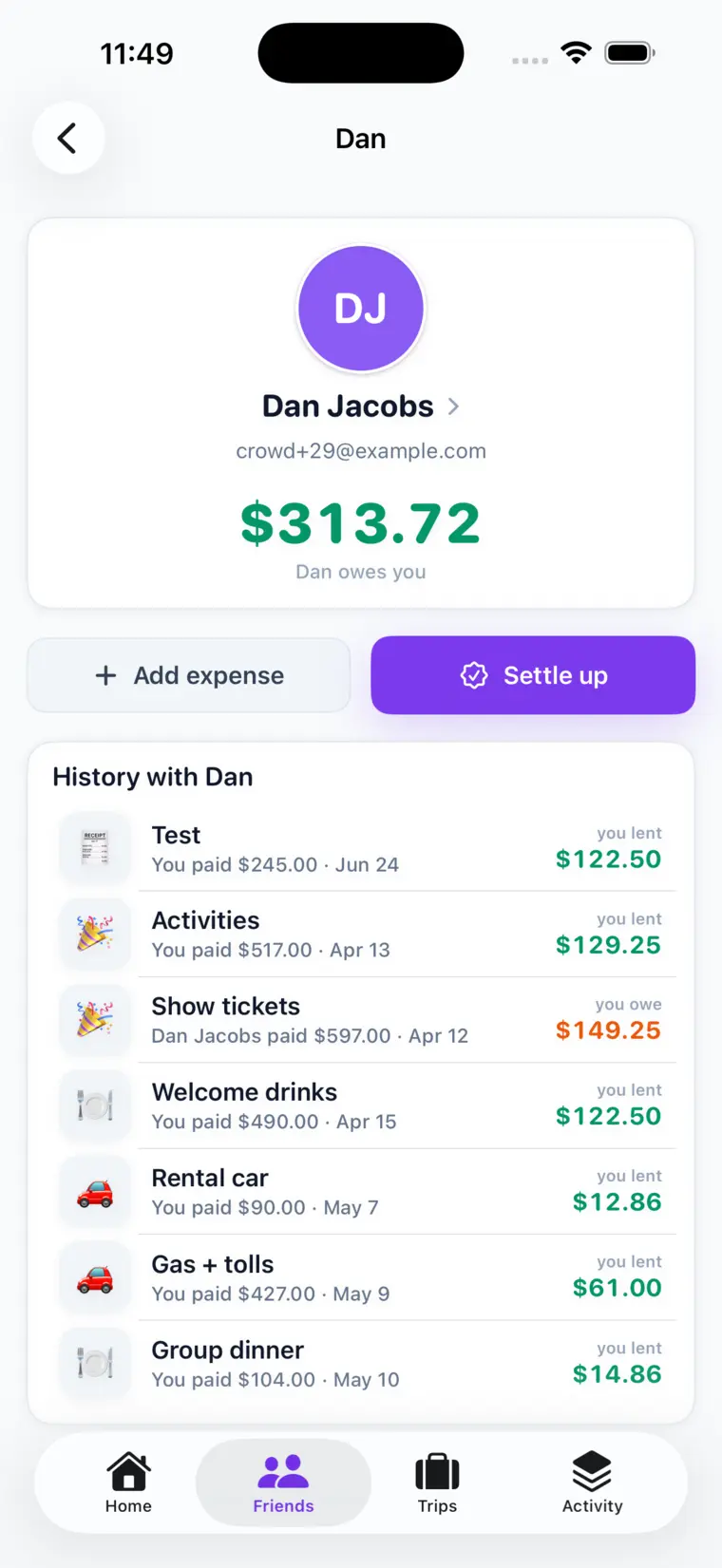
Go to the record and look at it together, rather than trading recollections. In Call It Even every expense keeps its date, its amount, who paid, and who it was split between, and the history shows when something was added or changed. That is usually enough to end it in under a minute.
- Open the expense. Date, amount, payer, and the people on the split are all there.
- Check the receipt. A photographed receipt ends “was that really $240?” instantly. Scanning an itemized one also means the split was built from the actual lines, not from someone’s estimate.
- Look at the history. If an expense was edited, the log shows it. Most “I’m sure that said $30” moments are a genuine early typo that somebody corrected.
- Send a share link. A read-only view of the group or the single expense opens in a browser without an account, so the other person can read the whole thing themselves instead of being told about it.
Pro Tip: Send the link before you send your conclusion. “Here’s everything from the weekend, have a look” lands very differently from “you owe me $112, here’s the proof.”
What if you disagree about what is fair, not what happened?
Accept that no ledger can decide it, and negotiate it like the ordinary disagreement it is. This is the harder and more common case: everyone agrees the bill was $260 and that Sam had the steak. What they disagree about is whether that matters.
| The disagreement | What usually resolves it |
|---|---|
| “I barely drank and the tab was mostly wine” | Split the food equally and put the bar on the people who drank, as an exact-amount split. |
| “I only stayed one night of the three” | Count person-nights and enter each person’s figure as exact amounts. |
| “I never use the thing we’re all paying for” | A forward-looking fix: change the split from next month, not retroactively. |
| “My share should be smaller — I earn less” | A conversation, not a calculation. If you agree, work out the figures and enter them as exact amounts. |
| “That shouldn’t have been a shared cost at all” | Delete or reassign the expense. Being wrong once is cheaper than defending it. |
In every one of these, the mechanic is the same: agree the number as humans, then record it. Call It Even splits equally or by exact amounts, so any arrangement you can agree on can be entered — you work out each person’s figure and the app checks that the parts add up to the total before saving.
How do you raise it without starting a fight?
Ask about the record, not about the person. Almost all the damage in these conversations comes from the opening sentence, because “I think you’ve got this wrong” and “can we check this together?” are the same request with very different accusations attached.
- Lead with the artefact. “I’ve got us at $84 apart — can you look and see if I’ve missed something?” invites a correction rather than a defence.
- Assume a mistake, not a motive. It is nearly always a mistake. Acting as though it is anything else guarantees the wrong outcome even when you are right.
- Do it early. A question about last night is administration; the same question about last March is an accusation.
- Do it privately. The group chat is not the place. Nobody concedes a point in front of an audience.
When should you just let it go?
When the amount is smaller than the friendship’s share of the conversation — and that threshold is far higher than most people admit. There is a real number below which being right is a bad trade, and the only person who can set it is you.
- Uncertain amounts: if you cannot evidence it, drop it. Absorbing a doubtful $18 buys more goodwill than it costs.
- One-offs with people you rarely split with: not worth a system or an argument.
- Anything you have already reminded twice about: a third reminder changes the relationship more than the balance.
- But not the recurring ones. A pattern is different from an amount. If the same person is short every single month, that is worth one honest conversation, precisely so it never becomes eleven resentful ones.
Pro Tip: Most “they never pay me back” stories are really “I never told them.” Log it, let them see it, and the vast majority of imbalances resolve themselves without anyone having to be confronted at all.
How do you avoid the disagreement entirely?
Make the record public and immediate, so there is never a gap between what happened and what everyone knows. Disputes grow in that gap.
- Log at the table. Ten seconds, while everyone can still see the bill.
- Split it in front of people. Anyone who objects will object then, when it is easy to change.
- Attach receipts to anything large. Not because you distrust anyone, but so nobody has to trust anybody.
- Settle in rhythm. Small, frequent settlements never accumulate enough history to argue about.
- Remember it never moves money. Call It Even is a ledger, not a bank — you pay each other however you already do and record it, so there is one number and one story.
Key takeaways
| Situation | What to do |
|---|---|
| You disagree about what happened | Look at the record together — date, amount, payer, receipt, and the edit history. |
| You disagree about what is fair | No record can decide it. Agree it as people, then enter the figures as an exact-amount split. |
| You need to raise it | Lead with the artefact, assume a mistake, do it early and privately. |
| The amount is small or unprovable | Let it go. Being right is sometimes a bad trade. |
| It keeps happening | Address the pattern once, kindly, rather than the amount eleven times. |
| You want to prevent it | Log at the table, split in public, attach receipts, settle often. |
FAQ
How do you prove what someone owes you?
Show the record rather than describing it: each expense keeps its date, amount, payer and split, receipts can be attached, and the history shows any later edits. A read-only share link lets the other person read all of it in a browser without an account, so the numbers answer their own questions.
What if a friend says an expense is wrong?
Open it together and check the amount, the receipt and the edit history — most disputes are an early typo somebody corrected. If they are right, change it. Being wrong once is far cheaper than defending it.
How do you handle someone who thinks the split is unfair rather than wrong?
Treat it as a negotiation, not a calculation, because no ledger can settle it. Agree the arrangement between you, then work out each person’s figure and enter it as an exact-amount split, which verifies the parts add up to the total.
Should you chase small amounts between friends?
Usually not — if you cannot evidence it, or you have already reminded twice, the reminder costs more than the money. A repeating pattern is different: address that once and honestly, so it does not turn into months of quiet resentment.
How do you stop money arguments with friends before they start?
Close the gap between what happened and what everyone knows: log expenses at the table, split them in front of people, attach receipts to anything large, and settle often enough that no long history builds up.
Recommended
- The Psychology of Who Owes Who – Call It Even
- How to Settle Debts in a Friend Group Fairly – Call It Even
- Expense Visibility Benefits for Groups – Call It Even
- Share Links – Call It Even