

To split an itemized receipt fairly, assign each line to whoever actually ordered it, then spread tax and tip across everyone in proportion to what they had. Doing that by hand at a table is miserable, which is why most groups give up and split evenly — and why the person who had a salad quietly subsidises the person who had the ribeye. Call It Even scans the receipt, reads the lines, and lets you drag each one to a person, so the fair split takes about as long as the unfair one.
When should you split a bill by item instead of evenly?
When the gap between the biggest and smallest order is large enough that someone would notice — in practice, once it is more than about ten dollars. Below that, an even split is faster and the difference washes out over a few dinners. Above it, evenly is just a transfer from the light eaters to the heavy ones.
- Split evenly when everyone ate roughly the same, or the group eats together often enough that it evens out.
- Split by item when there is a big spread, when someone is not drinking, or when one person’s order is most of the bill.
- Split the extras separately — a shared appetiser goes to whoever picked at it, not to the table by default.
How do you handle tax and tip on an itemized split?
Apply them proportionally to what each person ordered, not equally per head. This is the part hand-math almost always gets wrong. Tax and tip are a percentage of the food, so a person whose order was 40% of the subtotal owes 40% of the tip — splitting the tip evenly quietly re-introduces the exact unfairness you split by item to avoid.
| Part of the bill | How to split it |
|---|---|
| Individual dishes and drinks | To the person who ordered them. |
| Shared plates | Equally among whoever actually shared them. |
| Tax | Proportional to each person’s subtotal. |
| Tip | Proportional to each person’s subtotal. |
| A flat service charge or corkage | Equally — it applied to the table, not to an order. |
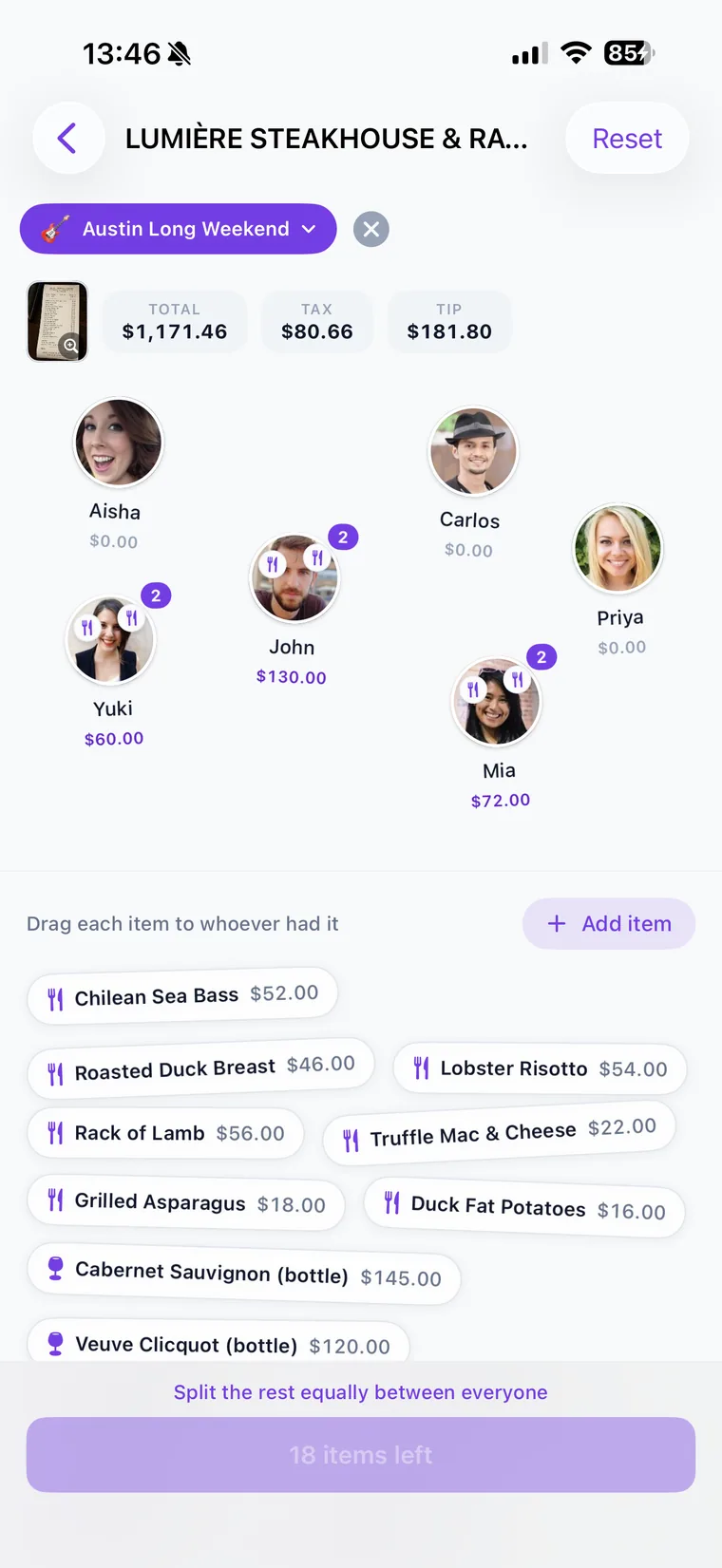
How does scanning a receipt work?
You photograph the receipt, it comes back as a list of lines with prices, and you assign each line to a person by tapping or dragging. Tax and tip are applied on top proportionally, and the resulting per-person figures are saved as the split.
- Snap it before you leave. A receipt in your pocket is a receipt you will forget; the whole point is that it takes seconds.
- Check the lines. Receipt printers produce some genuinely strange abbreviations — glance over the parsed list before assigning.
- Assign, don’t retype. Dragging fourteen lines to five people is fast; typing fourteen amounts is not.
- Shared items go to several people. Put the nachos on everyone who ate them.
- The receipt stays attached. It ends the “was that really $240?” conversation before it starts.
Every account gets free scans each month — two with a verified email and three more with a verified phone — which comfortably covers the long grocery and restaurant receipts that are actually worth scanning.
Pro Tip: Photograph the receipt while you are still at the table, even if you assign the lines later. The scan is the part that has to happen in the moment; the arithmetic can wait until you are in the car.
What if you don’t have the receipt?
Work out each person’s figure yourself and enter it as an exact-amount split. Call It Even splits equally or by exact amounts, so any arrangement you can agree on can be recorded — the app just verifies that the parts add up to the total before saving, which is the check hand-math never gets.
- Estimate honestly and round in the group’s favour. Absorbing a doubtful two dollars costs less than the conversation about it.
- Log it the same day. A reconstructed bill gets less accurate every hour.
- Say what you did. “I put you down for $31, shout if that’s off” invites a correction rather than a dispute.
How do you split a grocery receipt with a housemate?
Split the household staples equally and assign the personal items to whoever bought them — a shop is almost never entirely shared. This is where scanning earns its keep, because a supermarket receipt is forty lines long and nobody is typing that twice a week.
- Shared: cleaning supplies, oil, rice, milk if everyone drinks it.
- Personal: one person’s protein powder, someone’s particular brand of anything.
- The grey area: agree a rule once — most houses put snacks in “personal” and staples in “shared” and stop relitigating it.
Key takeaways
| Situation | What to do |
|---|---|
| Big spread between orders | Split by item — evenly is a subsidy from the light eaters. |
| Tax and tip | Proportional to each person’s subtotal, never equal per head. |
| Long receipt | Scan it and assign lines rather than typing amounts. |
| Shared plates | Split among whoever actually ate them. |
| No receipt | Work out each figure and enter it as an exact-amount split. |
FAQ
How do you split a restaurant bill by item?
Assign each dish and drink to whoever ordered it, split shared plates among the people who ate them, and apply tax and tip proportionally to each person’s subtotal. Scanning the receipt and assigning lines is far faster than doing it by hand, and it keeps the receipt attached as proof.
Should you split the tip evenly?
No — split it in proportion to what each person ordered. Tip is a percentage of the food, so splitting it evenly hands part of the big spender’s tip to the person who ordered least, which undoes the point of an itemized split.
How many receipt scans do you get for free?
Every account gets free scans each month: two with a verified email and three more with a verified phone. Call It Even is free forever with no fees and no bank details.
What if the scan misreads a line?
Check the parsed list before you assign — receipt printers use some very odd abbreviations. You can correct any line, and for a receipt you do not have at all, work out each person’s figure and enter it as an exact-amount split, which verifies the parts add up to the total.
How do you split a grocery receipt with roommates?
Split household staples equally and assign personal items to whoever bought them. Agree the rule once — most houses treat snacks as personal and staples as shared — and scan the receipt rather than typing forty lines.
Recommended
- Equal vs Itemized: The Fairest Way to Split a Bill – Call It Even
- How to Split a Bar Tab Fairly – Call It Even
- How to Split Groceries with Roommates – Call It Even
- Receipt Scanning – Call It Even
- How to Split Tax and Tip on a Group Bill – Call It Even