

Friends should split evenly when the difference is small enough that nobody is keeping score, and split by exact amounts when it isn’t. That sounds obvious, and yet an even split is the single most common source of quiet resentment in a friend group — because it is the default, it feels generous, and it is invisibly unfair to whoever consumed least. The useful question is not “what’s fair?” but “at what point does this stop being fair enough?”
Why do groups default to splitting evenly?
Because an even split is fast, socially frictionless, and signals that nobody is counting — three things a group values more than precision in the moment the bill lands. It also has a real benefit: it costs nothing to compute and it ends the conversation.
- It is generous-coded. Asking to itemize can read as stingy, even when it isn’t.
- It is quick. Everyone wants to leave the restaurant.
- It usually evens out. Over a long friendship of many dinners, the ribeye and the salad trade places.
That last one is the honest case for even splits, and it holds — right up until it doesn’t.
When does an even split stop being fair?
When the gap is large, repeated, or structural. Any one of those turns an even split from a rounding error into a transfer.
| Signal | What it means |
|---|---|
| Large — one order is much bigger than another | Someone notices tonight. Split by item. |
| Repeated — the same person always orders more | It will never “even out”; the trade never happens. |
| Structural — one person doesn’t drink, or is much tighter on money | Every even split costs them more in real terms. |
| Asymmetric benefit — one person barely used the thing | The cost and the benefit have come apart. |
The alcohol case deserves calling out, because it is the most common and the least discussed. A non-drinker at a table where the bar tab is half the bill is subsidising an activity they did not take part in, every single time. Nobody intends it, and almost nobody fixes it.
How do you split unevenly without being “that person”?
Set the rule before the bill arrives, not after — the entire social cost of an uneven split is in the timing. Proposing it up front is planning; proposing it once the total is on the table reads as an audit of what your friends ordered.
- Say it when you sit down. “Shall we just put drinks separately?” costs nothing before anyone has ordered.
- Make it about the category, not the person. “Drinks separate” is a rule; “Dan had four beers” is an accusation.
- Volunteer against your own interest first. If you’re the one who ordered most, propose it yourself. It lands completely differently.
- Let the record do the talking. Numbers everyone can see are much less confrontational than a person announcing figures.
Pro Tip: The cheapest fix for the drinks problem is a standing rule, agreed once, that never has to be renegotiated: food splits evenly, the bar tab splits between whoever drank. After the first time, nobody thinks about it again.
How do you actually record an uneven split?
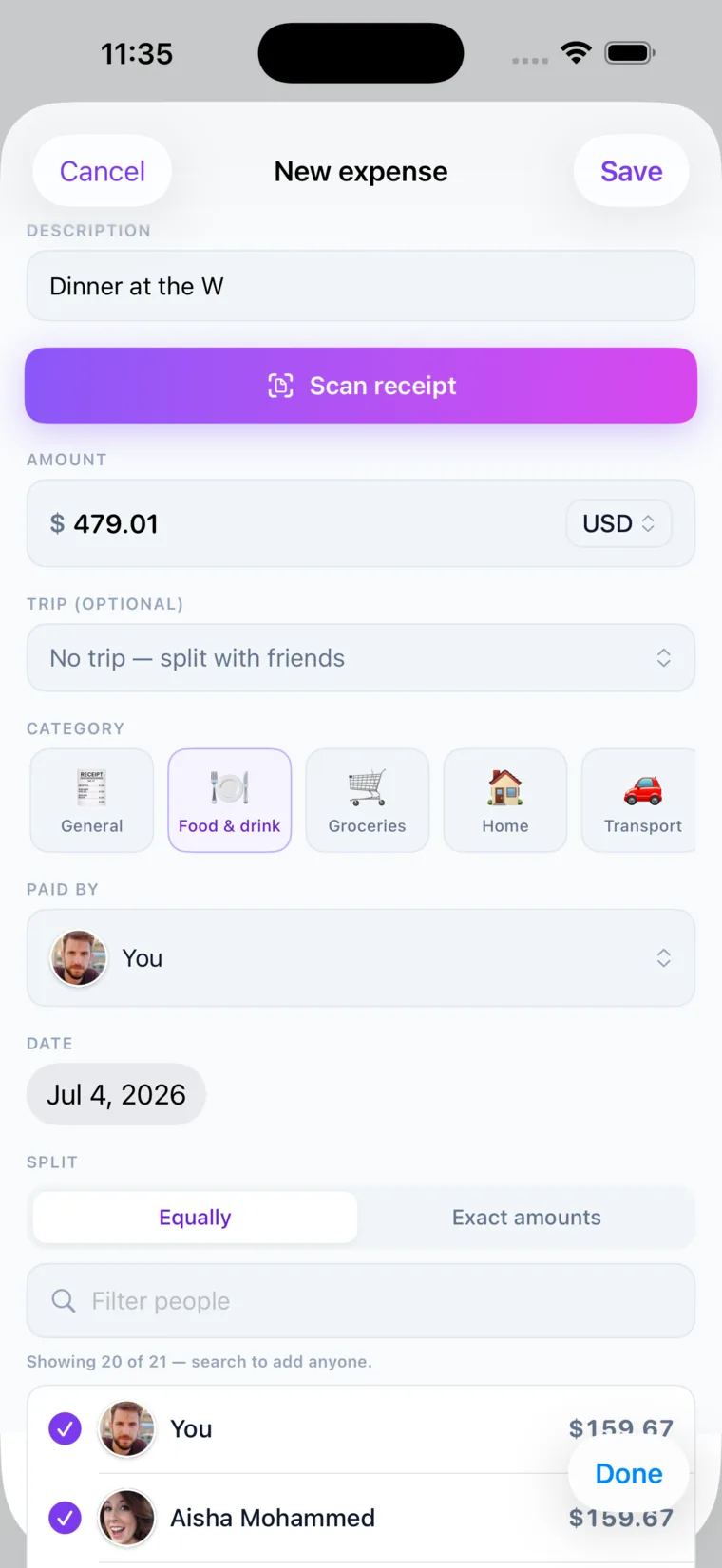
Work out each person’s figure and enter it as an exact-amount split. Call It Even splits equally or by exact amounts — so whatever arrangement you agree between you, from a 60/40 to a per-night pro-rata, is recorded by entering the numbers. The app verifies the parts add up to the total before saving, which is the check that hand-math never gets.
- Even split: tick everyone and save.
- By item: scan the receipt and assign each line, with tax and tip following each person’s subtotal.
- Any agreed arrangement: compute each share, enter as exact amounts.
The important part is that the split is visible. Most bad feeling about money between friends is not about the number — it is about finding out the number later.
What about friends with very different incomes?
Treat it as a choice about what you do, not a formula applied to the bill. Income-scaled splitting works between partners and sometimes housemates, where the finances are already entangled. Between friends it usually backfires, because it requires everyone to disclose and compare earnings to settle a $60 dinner.
- Choose cheaper venues rather than adjusting shares — it fixes the problem without anyone having to say they can’t afford it.
- Let people opt out of the expensive parts without making it a discussion.
- If someone offers to cover more, let them, and don’t turn it into a standing expectation.
- Never make someone ask. The ask is the expensive part, not the money.
Key takeaways
| Situation | Split |
|---|---|
| Similar orders, group eats together often | Evenly. It genuinely evens out. |
| Big spread in one bill | By item — scan the receipt and assign lines. |
| Someone isn’t drinking | Standing rule: food even, bar tab between drinkers. |
| A repeated pattern | Fix the rule, not the individual bill. |
| Very different incomes | Change where you go rather than how you split. |
| Any agreed arrangement | Enter each person’s figure as an exact-amount split. |
FAQ
Is it rude to ask not to split the bill evenly?
Not if you ask before the food arrives. Almost all of the social cost comes from raising it after the total is known, which reads as auditing what your friends ordered. Framed as a category rule — “shall we put drinks separately?” — and proposed at the start, it is completely unremarkable.
How do you split a bill when you don’t drink?
Agree a standing rule that food splits evenly and the bar tab splits between whoever drank. It only needs saying once, it never has to be renegotiated, and it removes what is probably the largest recurring unfairness in group dining.
Should friends split costs based on income?
Usually not — it requires everyone to disclose and compare earnings to settle a small bill, which costs more socially than it saves. Choosing cheaper venues and letting people skip the expensive extras solves the same problem without anyone having to explain their finances.
How do you record an uneven split in Call It Even?
Work out each person’s figure and enter it as an exact-amount split; the app confirms the parts add up to the total before saving. For a restaurant bill, scanning the receipt and assigning lines does the same thing faster, with tax and tip following each person’s subtotal.
What is the fairest way to split costs with friends?
The one everyone knows about in advance. Fairness here is mostly about visibility and timing rather than arithmetic — a split agreed up front and visible to everyone causes far less friction than a more precise one revealed afterwards.
Recommended
- Equal vs Itemized: The Fairest Way to Split a Bill – Call It Even
- The Psychology of Who Owes Who – Call It Even
- How to Split a Bar Tab Fairly – Call It Even
- When Friends Disagree About Who Owes What – Call It Even
- How to Split Costs When Money Is Tight – Call It Even